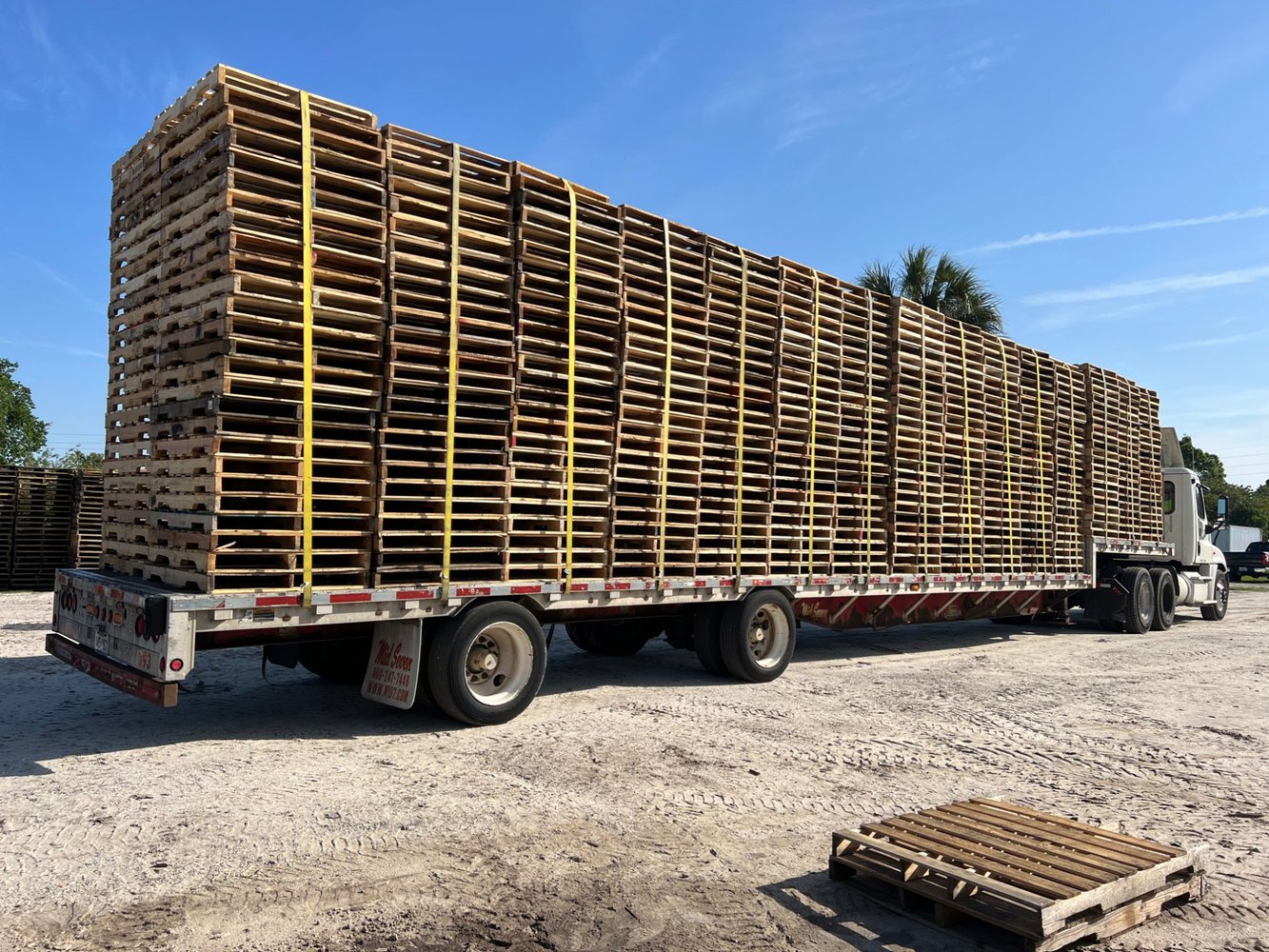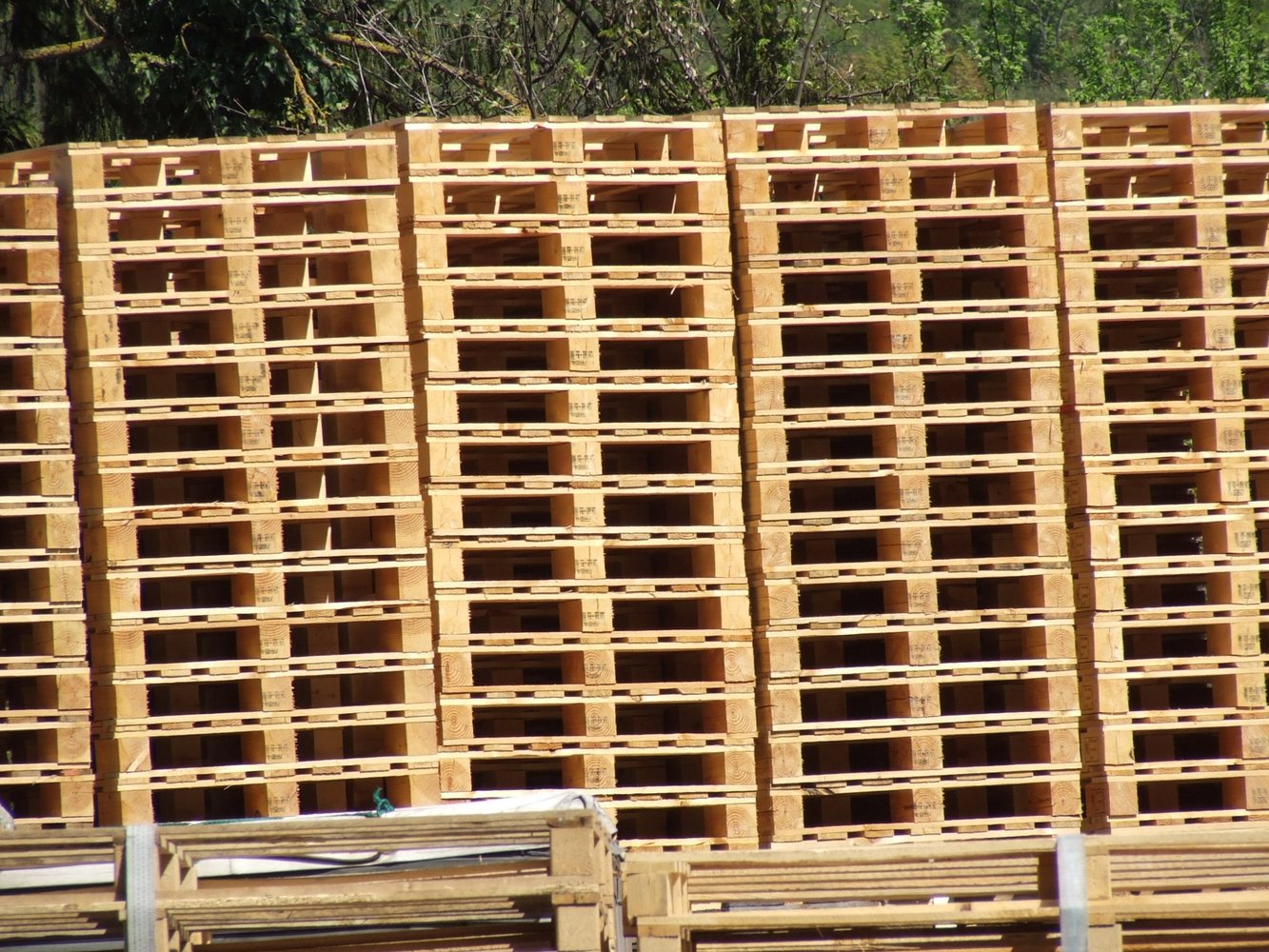
Wood pallets are flat transport platforms made from lumber used to store, handle, and ship goods throughout the supply chain. The standard wood pallet in North America is the GMA 48x40 inch pallet, which handles approximately 80% of all pallet traffic across US warehouses, distribution centers, and retail supply chains. Wood pallets are available in new and recycled grades, standard and custom sizes, and with or without heat treatment certification for export use.
This guide covers every aspect of wood pallets relevant to buyers in Florida, Georgia, New Jersey, Maryland, and Delaware: how pallets are graded, what sizes are available, which wood species are used, when heat treatment is required, what food grade compliance means, and how to source pallets at the right price for your operation.
What Is a Wood Pallet?
Pallet Lumber & Sawmill Operations
Stamped kiln-dried pallet lumber, bulk warehouse stock, dimensional yard inventory, raw softwood logs, and sawmill operations - the supply chain behind every custom and standard pallet we ship.


A wood pallet is a rigid transport structure composed of three main components: top deck boards (the flat surface that holds the load), bottom deck boards (the floor contact surface), and either stringers (horizontal boards running the length of the pallet) or blocks (9 square blocks at the corners, mid-points, and center) connecting the top and bottom decks and creating the space for forklift entry.
Wood pallets are built from softwood species such as Southern Yellow Pine and Douglas Fir, or hardwoods such as oak and maple, depending on application. The choice of construction method - stringer vs block - determines how forklifts and pallet jacks can access the pallet and affects its structural performance under load.
The majority of commercial pallets in the United States are stringer pallets built to GMA (Grocery Manufacturers Association) specifications. These are the brown rectangular platforms you see stacked in virtually every warehouse, distribution center, grocery store backroom, and manufacturing facility in the country.
Types of Wood Pallets
Stringer Pallets
Stringer pallets are the most common wood pallet type in North America. They are built with three or four parallel stringers running the length of the pallet, with deck boards nailed across the top and sometimes the bottom. The standard GMA 48x40 pallet is a 3-stringer pallet.
Stringer pallets are designated as two-way or four-way entry depending on how forklifts can approach:
- Two-way stringer pallets - fork entry only from the two short ends
- Notched stringer pallets (four-way) - notches cut into the stringers allow partial fork entry from all four sides
Stringer pallets are less expensive to manufacture than block pallets and dominate the recycled pallet market. Most recycled GMA pallets available from commercial suppliers in Florida and the Southeast are stringer construction.
Read more: Two-Way vs Four-Way Pallets: Which Do You Need?
Block Pallets
Block pallets use 9 wood blocks arranged in a 3x3 grid instead of stringers. The blocks elevate both the top and bottom deck boards, creating full four-way entry from all sides with a complete fork pocket. Block pallets are stronger, more stable, and easier to handle with pallet jacks than stringer pallets.
Block pallets are preferred in:
- Food and beverage production (easier to clean, no stringer gaps for debris accumulation)
- Pharmaceutical supply chains requiring GDP compliance
- High-racking warehouse systems with heavy loads
- Export shipments where pallet stability during transport is critical
Block pallets cost more than stringer pallets - new block pallets typically run 20% to 40% more per unit than equivalent stringer construction. However, they are more durable and last longer in high-cycle applications.
Read more: Block vs Stringer Pallets: Full Comparison
GMA Standard Pallets (48x40)
The GMA pallet is the North American standard pallet established by the Grocery Manufacturers Association. At 48 inches long and 40 inches wide, the GMA pallet fits the majority of US warehouse racking, truck trailers, and material handling equipment. GMA pallets account for approximately 35% of all wood pallets in circulation in the United States.
GMA pallet specifications:
- Dimensions: 48 inches x 40 inches
- Height: 5.5 inches (stringer) or 6.5 inches (block)
- Weight: 37 to 42 lbs (stringer), 50 to 60 lbs (block)
- Dynamic load capacity: 2,800 lbs
- Static load capacity: 30,000 lbs
- Racking capacity: 2,500 lbs
- Construction: 3-stringer or 9-block
Read more: GMA Pallet Standard 48x40: Complete Specifications Guide
Custom Size Pallets
Not all operations run on 48x40. Common non-standard wood pallet sizes include 42x42 (paint, drums, telecom), 48x48 (55-gallon barrels), 40x40 (dairy), 48x45 (automotive and aerospace), and 60x40 (military and oversize industrial). Custom pallets can be built to any dimension specified by the buyer.
Custom pallets are appropriate when:
- Your product footprint doesn't match standard GMA dimensions
- Your racking system requires a specific pallet depth
- You're shipping irregular loads that need a purpose-built base
- Your facility uses non-standard material handling equipment
Read more: Custom Pallet Sizes: When to Order Non-Standard Dimensions
Wood Pallet Grades: A, B, and C
Commercial wood pallets are graded on a three-tier system that reflects their condition, remaining useful life, and suitability for different applications. Grade A is the highest quality recycled pallet, Grade B is standard warehouse grade, and Grade C is economy grade for light-duty or single-use applications.
Grade A Premium Recycled
Grade A pallets are in excellent condition with no broken, missing, or split deck boards, no cracked or broken stringers or blocks, tight deck board spacing, and no paint or contamination from prior use. Grade A pallets are functionally equivalent to new pallets in most applications. They are the correct choice for food grade applications, pharmaceutical supply chains, clean room environments, and any application requiring a retailer compliance standard such as Walmart, Target, or Costco.
Grade B Standard Recycled
Grade B pallets are in good but not perfect condition. They may have one or two replacement boards, minor staining, or slight cosmetic wear but are structurally sound and suitable for standard warehouse and distribution use. Grade B is the workhorse of the commercial pallet supply market - the grade most businesses use for general inbound and outbound freight that doesn't require premium appearance or food grade certification. Grade B pallets typically cost 30% to 50% less than Grade A.
Grade C Economy
Grade C pallets have been repaired multiple times and show significant wear. They may have paint from prior loads, noticeably repaired boards, or cosmetic damage that disqualifies them from Grade B. Grade C pallets are structurally functional but should only be used in single-trip applications, light-duty storage, or temporary operations. Not suitable for food grade, pharmaceutical, or any retailer compliance application.
Read the full grading guide: Pallet Grades Explained: Grade A vs B vs C - What Each Means
Standard Wood Pallet Sizes
While the 48x40 GMA pallet dominates North American commerce, wood pallets come in a range of standard sizes tuned to specific industries:
| Size (L x W) | Primary Use | Industries |
|---|---|---|
| 48 x 40 inches | GMA standard - North American universal | Grocery, retail, general distribution |
| 42 x 42 inches | Drums, paint, chemical containers | Chemical, paint, telecom |
| 48 x 48 inches | Large drums, heavy equipment | Oil, barrels, industrial |
| 40 x 40 inches | Dairy production equipment sizing | Dairy, beverages |
| 48 x 45 inches | Automotive parts and assemblies | Automotive, aerospace |
| 60 x 40 inches | Military specification | Defense, government |
| 36 x 36 inches | Beverages (bottles and cans) | Beverage distribution |
| 48 x 20 inches | Half-pallet for retail floor displays | Retail, club stores, CPG |
Read more: Standard Pallet Sizes: All Dimensions and Industry Uses
New vs Recycled Wood Pallets
Every pallet buyer faces the new vs recycled decision. The right choice depends on your application, compliance requirements, and volume.
New Wood Pallets
New pallets are built from fresh lumber to exact specification. Benefits include: consistent dimensions and weight, no contamination risk, documentation for food grade and pharmaceutical applications, and the option to specify exact wood species, heat treatment, and construction details. New pallets cost 40% to 80% more per unit than equivalent recycled Grade A pallets.
New pallets are required or preferred for:
- FDA FSMA food safety compliance (HARPC-regulated supply chains)
- Pharmaceutical GDP compliance (GMP-regulated distribution)
- Pharmaceutical clean room and sterile product distribution
- Export shipments with strict documentation requirements
- Food processors and beverage producers with SQF or BRC certification
- First-time use applications where contamination history is unknown
Recycled Grade A Wood Pallets
Recycled Grade A pallets deliver 90% of new pallet performance at 40% to 60% of the cost. They are the best-value choice for most commercial operations that do not operate in FDA-regulated food or pharma supply chains. For general warehouse, distribution, manufacturing, and retail use, Grade A recycled pallets perform identically to new pallets under normal operating conditions.
Read the full comparison: New vs Recycled Pallets: Full Cost and Performance Comparison
Heat-Treated Wood Pallets (ISPM-15)
Heat-treated pallets are required for all international shipments from the United States and most other countries. ISPM-15 (International Standards for Phytosanitary Measures No. 15) is the international standard that governs wood packaging materials including pallets, crates, and dunnage used in international trade.
What ISPM-15 Requires
Under ISPM-15, wood pallets must be treated to kill wood-boring pests including bark beetles, pine wood nematode, and other invasive species that can spread through international wood trade. Heat treatment (HT) is the dominant method: the wood core temperature must reach 56 degrees Celsius for 30 continuous minutes. After treatment, pallets receive the official IPPC (International Plant Protection Convention) mark stamped or branded into the wood.
The IPPC mark format is: [country code] - [producer number] - HT (for heat treated)
A properly marked US heat-treated pallet shows: US - [number] - HT
Which Countries Require ISPM-15
ISPM-15 is required for wood packaging entering virtually all major trading partners of the United States including the European Union, United Kingdom, Canada, Australia, New Zealand, China, Japan, South Korea, Mexico, Brazil, and most other countries. The US requires incoming wood packaging to comply with ISPM-15 as well.
Exporters through Florida's ports (Port of Miami, Port Everglades, Port of Tampa) and through Port of Savannah, Port Newark, Port of Baltimore, and Port of Wilmington must use ISPM-15 certified pallets for all shipments leaving the country.
Read the full guide: ISPM-15 Heat Treatment: Complete Export Pallet Guide
Food Grade Wood Pallets
Food grade pallets are pallets that meet safety standards for use in food production, processing, distribution, and storage environments regulated by the FDA under the Food Safety Modernization Act (FSMA). Not all wood pallets qualify as food grade - specific conditions must be met.
What Makes a Pallet Food Grade
Under FDA FSMA HARPC (Hazard Analysis and Risk-Based Preventive Controls) requirements, food-contact and food-adjacent pallets must:
- Be free from chemical contamination, pesticides, and hazardous substances
- Have no visible mold, moisture damage, or biological contamination
- Be free from nails, staples, or hardware that could contaminate product
- Have no paint, stain, or chemical treatment other than ISPM-15 compliant heat treatment
- Ideally be new or certified Grade A from a known sourcing chain
- Be inspectable and documentable upon request from FDA auditors
Most food processors, beverage producers, and food distributors require new pallets or Grade A recycled pallets from verified sources for direct food contact. For indirect contact (outer cases only), Grade A recycled pallets are generally acceptable with documentation.
Read more: Food Grade Pallets in Florida: FSMA Compliance Guide
Wood Species Used in Pallet Manufacturing
The species of wood used in a pallet affects its weight, strength, density, and suitability for heat treatment. The two dominant species used in US pallet production are:
Southern Yellow Pine (SYP)
Southern Yellow Pine is the most widely used species for pallet manufacturing in the eastern and southeastern United States. SYP is a dense, strong softwood with excellent nail-holding strength and good resistance to splitting. Its high density makes it ideal for heat treatment - the wood responds well to the HT process required for ISPM-15 certification. SYP pallets are the standard in Florida, Georgia, the Carolinas, and most of the Southeast.
Hardwood Species (Oak, Maple, Ash)
Hardwood pallets are common in the Midwest and in specialty applications requiring maximum load capacity. Oak and maple pallets are heavier than SYP but significantly stronger. Hardwood pallets are preferred for very heavy industrial loads, automotive applications, and high-cycle racking environments. They are more expensive than SYP pallets but last longer under heavy-use conditions.
Read more: Pallet Wood Types: Which Species Is Best for Your Application?
Wood vs Plastic Pallets
Wood pallets dominate because they offer the best combination of cost, strength, repairability, and widespread availability. Plastic pallets are used in specific closed-loop and sanitation-critical applications but represent less than 5% of total pallet use in the United States.
| Factor | Wood Pallets | Plastic Pallets |
|---|---|---|
| Cost | $8-28 (recycled-new) | $40-200+ |
| Repairability | Easy - individual boards replaced | Limited - molded unit repairs poorly |
| Weight | 37-60 lbs | 15-30 lbs |
| Load capacity | 2,500-3,000 lbs dynamic | 1,500-2,500 lbs dynamic (typical) |
| Food grade | Yes (new or Grade A) | Yes (hygienic advantage in wash-down) |
| ISPM-15 required | Yes (for export) | No (exempt) |
| Availability | Immediate - standard supply chain | Lead time for specialty orders |
| Best for | All standard commercial use | Closed-loop food and pharma wash-down |
ⓘ Florida Pallet Supply can be more competitive for your area. Submit a free quote now →
How these prices were reconstructed
Updated 3 August 2026. Four of the seven rows above are figures this guide already published and are unchanged: Grade B at $5 to $9, New GMA Stringer at $15 to $28, the $14 top of the Grade A range, and the $2 to $5 heat-treatment premium noted against the ISPM-15 rows. Grade C at $3 to $6 is the published figure from our pallet cost guide. Two rows are derived and the arithmetic is here so you can check it: New GMA Block applies the 15% to 30% block premium published on our block vs stringer comparison to the new stringer range ($15 x 1.15 = $17.25, $28 x 1.30 = $36.40); the ISPM-15 rows apply the $2 to $5 heat-treatment premium already noted on those rows to the recycled and new base ranges. One honest caveat. The Grade A range on this page tops out a dollar higher than the $9 to $13 published on our pallet cost guide, and the new-pallet range here is wider than the range published there. This page quotes truckload conditions across Florida and the wider Southeast; the cost guide quotes our five-state service area, where we control the supply. If you want the tighter number, use the cost guide. If you are buying outside the service area, the wider range here is the more realistic one to budget against. Neither is a live quote, and a real number for your volume and drop point comes from a quote.
Read the full comparison: Wood vs Plastic Pallets: Full Comparison for Commercial Buyers
Wood Pallet Load Capacity
Understanding load capacity prevents product damage, equipment damage, and worker injury. Wood pallet load ratings are expressed three ways:
- Dynamic load capacity - weight the pallet can support while being moved by a forklift or pallet jack. Standard GMA: 2,800 lbs.
- Static load capacity - weight the pallet can support while stationary on a solid floor. Standard GMA: 30,000 lbs.
- Racking capacity - weight the pallet can support when stored on racking beams with unsupported span. Standard GMA: 2,500 lbs.
Racking capacity is the most restrictive rating and the most important for warehouse operations. A pallet that holds 4,000 lbs on a solid floor may only safely hold 2,500 lbs on rack beams, because the center of the pallet is unsupported and bends under load.
Never exceed racking capacity. The racking load rating - not floor load rating - is the operative number for any pallet stored in selective, drive-in, or push-back racking.
Read more: Wood Pallet Load Capacity Guide: Dynamic, Static, and Racking Ratings
How to Inspect Wood Pallets on Receiving
Every pallet delivery should be inspected before pallets enter your facility. The inspection process protects you from receiving subgrade pallets billed as premium, identifies structural defects before they cause product damage, and documents pallet condition for compliance records.
Key inspection criteria for wood pallets:
- All deck boards present - no missing boards
- No broken, cracked, or split deck boards
- All stringers or blocks intact - no cracked, missing, or severely split stringers
- No protruding nails or staples above deck surface
- No visible mold, moisture damage, or soft spots (for food grade applications)
- No paint, chemical staining, or contamination residue
- IPPC mark present on heat-treated pallets (if required)
- Pallet is square - no racking or diagonal warping
- Deck boards flush and tight - no excessive gaps (>3 inches for food grade)
Full checklist: Pallet Inspection and Receiving Checklist
Wood Pallet Pricing Guide (2026)
Wood pallet prices fluctuate with lumber markets, fuel costs, and regional supply and demand. The following ranges reflect Florida and Southeast market conditions in 2026 for standard GMA 48x40 pallets purchased in truckload quantities (typically 300-500 units per load):
| Pallet Type | Price Per Pallet (Truckload) | Notes |
|---|---|---|
| Recycled Grade A | $9 to $14 | Premium recycled, food grade eligible with documentation |
| Recycled Grade B | $5 to $9 | Standard warehouse use |
| Recycled Grade C | $3 to $6 | Single-trip or light duty only |
| New GMA Stringer | $15 to $28 | Standard new construction |
| New GMA Block | $17 to $36 | Block construction, food and pharma preferred |
| ISPM-15 Heat Treated (recycled) | $11 to $19 | Adds $2-5 premium over base grade |
| ISPM-15 Heat Treated (new) | $17 to $33 | New with export certification |
ⓘ Florida Pallet Supply can be more competitive for your area. Submit a free quote now →
Prices above are per-pallet estimates for truckload quantities in FL/GA. Smaller quantities command higher per-unit pricing. Request a free quote online for current pricing in your area.
Read more: Wood Pallet Cost Guide: Pricing Factors, Market Rates, and How to Reduce Costs
How to Buy Wood Pallets: Buyer's Guide
Buying pallets efficiently requires understanding what grade and specification your application demands, how much volume you need, and whether you want spot buys, scheduled deliveries, or an ongoing supply contract.
Step 1: Define Your Grade Requirement
Before contacting any supplier, identify your minimum acceptable grade. If you operate in a food or pharmaceutical supply chain, you may require new or certified Grade A with documentation. If you run a general distribution operation, Grade B is usually the right cost-performance balance. Grade C works for light-duty or temporary applications.
Step 2: Confirm Your Size and Construction Requirement
Most buyers need 48x40 GMA pallets. If your racking, conveyor, or material handling equipment is sized for a specific pallet dimension, confirm it before ordering. Custom sizes require lead time and minimum quantities.
Step 3: Determine Export or Compliance Requirements
If any of your product leaves the country, you need ISPM-15 certified heat-treated pallets. If you supply Walmart, Target, Costco, Publix, Whole Foods, or other major retailers, confirm their pallet specification requirements before ordering.
Step 4: Calculate Volume and Delivery Cadence
Estimate your weekly or monthly pallet consumption. Buyers who commit to recurring scheduled deliveries get better per-unit pricing than spot buyers. If you have storage for 500+ pallets, ordering full truckloads reduces your cost per unit versus smaller more frequent orders.
Step 5: Get Multiple Quotes and Compare Total Cost
Per-pallet price is only part of the cost. Factor in delivery fees, minimum order quantities, lead time reliability, and the cost of rejects. A supplier offering pallets at $1 less per unit but delivering 10% rejects costs you more than a supplier with consistent Grade A at full price.
Read more: Small Business Guide to Buying Pallets
Wood Pallets by Industry
Food and Beverage
The food and beverage industry is the largest consumer of wood pallets in the United States. Food processors, beverage producers, and grocery distributors require Grade A or new pallets meeting FDA FSMA standards. Block pallets are preferred for food grade applications because they are easier to sanitize and inspect. Many food facilities require ISPM-15 certified pallets for all incoming product regardless of whether the shipment is domestic - this prevents any pathway for potential pest introduction.
Pharmaceutical and Healthcare
Pharmaceutical supply chains require pallets that meet GDP (Good Distribution Practice) requirements. New pallets or certified Grade A pallets with full sourcing documentation are standard. Temperature-controlled (cold chain) pharmaceutical operations additionally require pallets that maintain structural integrity in refrigerated and frozen environments without absorbing moisture that could contaminate product.
Retail Distribution
Major retailers including Walmart, Target, Costco, and Amazon have specific pallet requirements that suppliers must meet. Most require GMA 48x40 pallets in Grade A condition or better. Pallets must arrive without visible damage, with consistent deck board spacing, and without contamination. Non-compliant pallets can result in chargebacks and rejected shipments.
Agriculture and Export
Florida's agriculture industry - particularly citrus, tomato, and fresh produce - uses high volumes of pallets for field packing and cold storage. Export produce requires ISPM-15 certified pallets for shipment through Port Everglades and Port of Miami. Citrus season drives a significant surge in pallet demand in Central and South Florida from October through April.
Manufacturing and Industrial
Manufacturing facilities use heavy-duty wood pallets for auto parts, building materials, machinery components, and industrial goods. Custom pallet sizes are more common in manufacturing than in distribution. Block pallets with high racking capacity are preferred for heavy-load racking applications.
Where to Buy Wood Pallets in Florida, Georgia, NJ, MD, and DE
Florida Pallet Supply delivers wood pallets to businesses across all five states. We carry GMA 48x40 pallets in new and recycled grades A, B, and C, plus block pallets, ISPM-15 heat-treated pallets, and custom sizes. Delivery by dry van, flatbed, drop trailer, or live load.
Florida
All 67 counties. Same-day and next-day delivery in major metros (Miami, Orlando, Tampa, Jacksonville). FL Buying Guide →
Georgia
All 159 counties. Atlanta metro, Port of Savannah corridor, North Georgia manufacturing belt. GA Buying Guide →
New Jersey
All 21 counties. NJ pharma corridor, Port Newark, dense distribution hub. NJ Buying Guide →
Maryland
All 24 counties. Port of Baltimore, NIH/FDA biotech corridor, DC metro distribution. MD Buying Guide →
Frequently Asked Questions About Wood Pallets
Related Pallet Guides
Pallet Grades A, B, C Explained
Full breakdown of GMA grading standards and which grade you need
GMA 48x40 Pallet Standard
Complete specifications, dimensions, and load ratings
ISPM-15 Heat Treatment Guide
Export requirements, IPPC mark, and country requirements
New vs Recycled Pallets
Cost and performance comparison for commercial buyers
Block vs Stringer Pallets
When to use each construction type
Wood Pallet Cost Guide
Market rates, pricing factors, and cost reduction strategies
Food Grade Pallets: FSMA Guide
FDA compliance requirements for food supply chains
Small Business Pallet Buying Guide
How to source quality pallets at the right price
Pallet Inspection Checklist
Receiving standards and reject criteria
Custom Pallet Sizes Guide
Non-standard dimensions and how to spec a custom order
Florida Pallet Buying Guide
Where to buy, pricing, and delivery in Florida
Georgia Pallet Buying Guide
Pallet supply and pricing across Georgia
Need wood pallets in FL, GA, NJ, MD, or DE? Request a free quote online. We respond within one business day.
GET A PRICE →