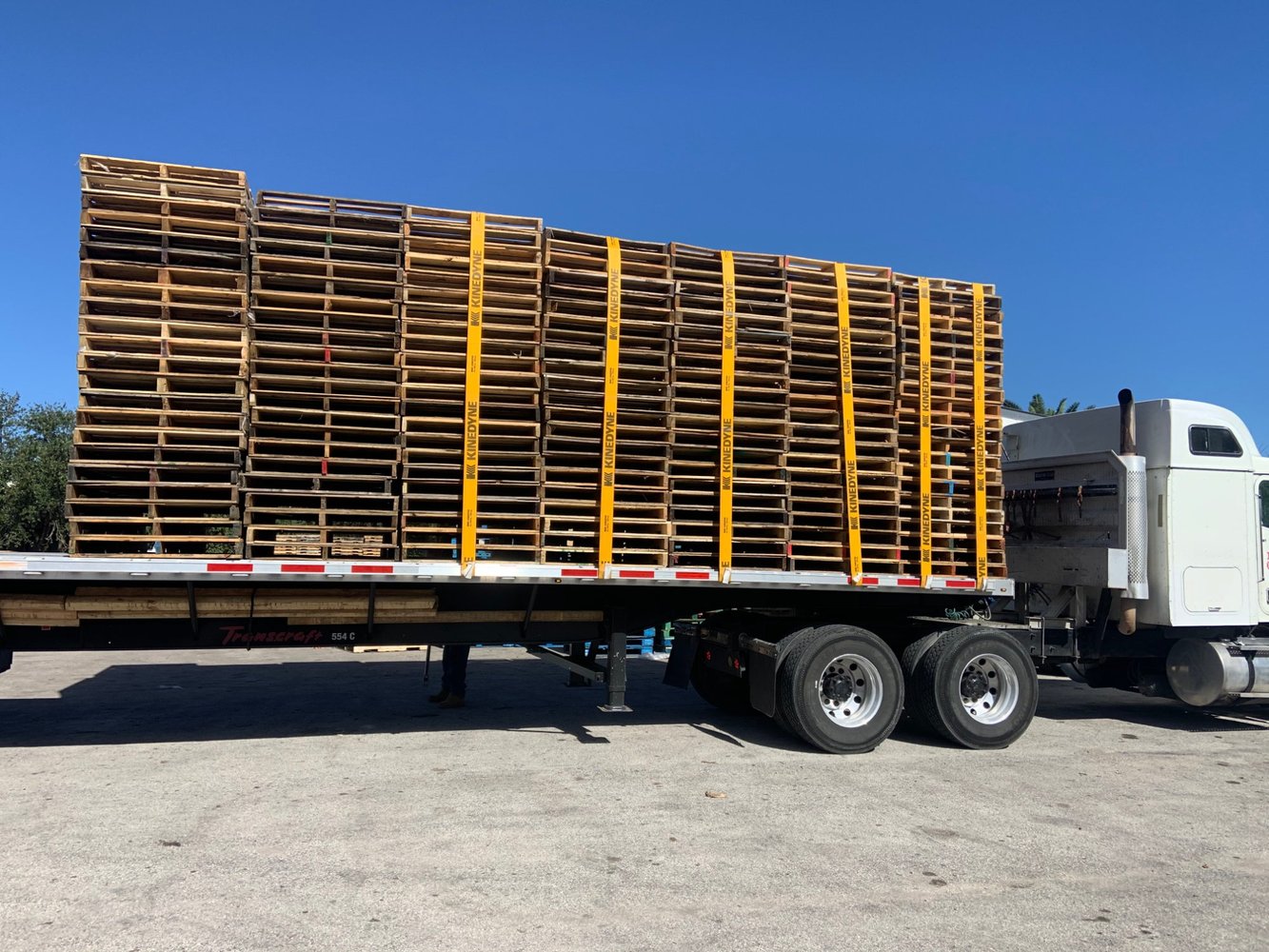
One of the most common and costly mistakes in warehouse operations is assuming all pallets hold the same amount of weight. A standard GMA 48x40 stringer pallet is rated for 2,800 pounds of dynamic load -- but that rating assumes specific conditions that are routinely violated in real warehouse environments. Understanding load ratings, the difference between dynamic and static capacity, and how pallet type, condition, and temperature affect these numbers can prevent product damage, forklift accidents, rack collapses, and OSHA citations.
📨 Need pallets with documented load ratings for your warehouse or compliance program? We supply Grade A and new pallets with full specification sheets across FL, GA, NJ, MD, and DE.
Get Spec Sheet →Dynamic vs. Static Load Capacity: The Critical Difference
Pallet Lumber & Sawmill Operations
Stamped kiln-dried pallet lumber, bulk warehouse stock, dimensional yard inventory, raw softwood logs, and sawmill operations - the supply chain behind every custom and standard pallet we ship.


Pallet manufacturers and industry standards recognize two fundamentally different load rating types, and confusing them is one of the most common causes of pallet failures in warehouses:
- Dynamic load capacity: The maximum weight a pallet can safely carry while being moved by a forklift, pallet jack, or conveyor system. Movement creates additional stress forces on the pallet -- particularly on the stringers or blocks at the fork entry points. The standard GMA dynamic rating is 2,800 lbs for a 48x40 stringer pallet.
- Static load capacity: The maximum weight a pallet can support while sitting on the floor without moving. Because static loads distribute evenly across the full contact area, static capacity is dramatically higher -- typically 30,000 lbs for a GMA pallet. This is why fully loaded pallets on warehouse floors rarely fail even with very heavy products.
- Racking load capacity: A separate rating for when a pallet is placed on beam-style rack uprights. Racking creates a "bridge" stress condition where the pallet must support the load across a span rather than distributing to a flat surface. Typical GMA racking capacity is 2,800 lbs, but many facilities reduce this to 2,000-2,500 lbs as a safety margin when using recycled pallets.
Load Capacity by Pallet Type (2026)
Pallet type, size, construction method, and condition all significantly affect how much weight a pallet can safely hold. The table below reflects industry-standard ratings for new pallets in good condition:
| Pallet Type | Size | Dynamic Capacity | Static Capacity | Rack Capacity |
|---|---|---|---|---|
| GMA Stringer (New) | 48x40 | 2,800 lbs | 30,000 lbs | 2,800 lbs |
| GMA Stringer (Grade A) | 48x40 | 2,500 - 2,800 lbs | 25,000 - 30,000 lbs | 2,000 - 2,800 lbs |
| GMA Stringer (Grade B) | 48x40 | 1,800 - 2,500 lbs | 18,000 - 25,000 lbs | 1,500 - 2,000 lbs |
| GMA Stringer (Grade C) | 48x40 | 1,000 - 1,800 lbs | 10,000 - 18,000 lbs | Not Recommended |
| Block Pallet (New) | 48x40 | 4,000 - 5,000 lbs | 30,000 - 50,000 lbs | 3,000 - 5,500 lbs |
| Plastic (Nestable) | 48x40 | 2,000 - 2,500 lbs | 20,000 - 25,000 lbs | Not Rated (floor only) |
| Plastic (Rackable) | 48x40 | 2,500 - 4,000 lbs | 25,000 - 35,000 lbs | 2,500 - 4,000 lbs |
| Custom 48x48 | 48x48 | 3,000 - 4,000 lbs | 30,000+ lbs | 2,500 - 3,500 lbs |
What Reduces Pallet Load Capacity
Published load ratings assume new pallets in perfect condition, properly supported loads, and ambient temperature. Real-world conditions routinely reduce effective capacity:
| Factor | Capacity Impact | Why It Matters |
|---|---|---|
| Pallet age / wear | -10% to -40% | Wood fibers weaken, fastener joints loosen, stringers develop micro-cracks over cycles |
| Moisture / wet conditions | -20% to -50% | Waterlogged wood loses structural strength; nails loosen from swollen then dried wood |
| Cold storage (< 32°F) | -15% to -30% | Thermal cycling fatigues wood; condensation on transition causes rapid decay in high-cycle use |
| Off-center loading | -15% to -35% | Unbalanced loads concentrate stress on one stringer or block; rated capacity assumes centered load |
| Notched or repaired stringers | -20% to -50% | Each repair reduces the cross-sectional area of the stringer that carries the load |
| Overhang (load extends past deck edge) | -10% to -40% | Overhang creates cantilever bending stress on deck boards; OSHA flags this as a hazard |
| Forklift single-tine entry | -40% to -60% | If only one tine fully enters, the load is carried asymmetrically -- catastrophic failure risk on heavy loads |
Common Products and Typical Pallet Weights
Understanding where your typical loads fall relative to pallet ratings helps you choose the right grade and type. These are real-world pallet load weights by product category:
| Product Category | Typical Pallet Weight | Recommended Pallet |
|---|---|---|
| Beverages (canned, bottled) | 1,800 - 3,000 lbs | GMA Grade A or Block (new), full deck boards |
| Packaged dry food (cereal, snacks) | 600 - 1,400 lbs | GMA Grade A or B -- well within standard limits |
| Fresh produce (boxes) | 1,200 - 2,200 lbs | GMA Grade A -- food-grade certified |
| Construction materials (tile, stone) | 2,500 - 5,000 lbs | New block pallet -- do not use Grade B/C for heavy stone |
| Automotive parts (engines, transmissions) | 1,500 - 4,000 lbs | Custom block pallet or rated heavy-duty stringer |
| Paper / printing materials | 2,000 - 3,500 lbs | GMA Grade A or block pallet |
| Pharmaceuticals (cases) | 400 - 1,200 lbs | New block pallet (GDP) -- not about weight, about documentation |
| Chemicals (drums, IBC totes) | 1,500 - 4,000 lbs | New or Grade A block pallet -- chemical resistance matters |
| E-commerce fulfillment (mixed SKU) | 500 - 1,500 lbs | GMA Grade B or A depending on racking requirements |
Block Pallets vs. Stringer Pallets: Load Capacity Explained
The structural difference between block and stringer pallets directly affects how much weight they can safely carry:
Stringer Pallets
Three parallel longitudinal boards (stringers) carry the load from deck boards to the floor or forklift tines. The stringer is the load-bearing member -- any damage to it directly reduces capacity. Forklift entry is 2-way (long sides only) on standard stringers; notched stringers allow partial 4-way entry but each notch reduces stringer cross-section by 30-50%. Standard rating: 2,800 lbs dynamic.
Block Pallets
Nine hardwood or composite blocks at each intersection of top and bottom deck boards distribute load across a much wider base. True 4-way forklift entry means all four sides can be entered cleanly without weakening the load-bearing members. Block pallets typically rate 4,000-5,500 lbs dynamic for new units, making them preferred for heavy industrial, pharmaceutical, and automotive applications.
Why Grade Matters More Than Type
A Grade C stringer pallet may have lower effective capacity than a Grade A equivalent because damage -- split stringers, missing blocks, broken deck boards -- directly reduces load-bearing area. Always match the grade to the load, not just the nominal type. For racking applications specifically, Grade B or C pallets in beam racks is a common cause of rack collapse injuries.
Racking: The Most Dangerous Application
Racking is where pallet capacity errors cause the most harm. A pallet in a beam rack spans two rail beams that may be 42-44 inches apart. This span-load condition creates bending stress that far exceeds ground-level stress. Use Grade A or new pallets for racking -- never Grade C. Post maximum load limits on all rack bays per OSHA 29 CFR 1910.176(b).
Forklift and Pallet Capacity: How They Interact
A forklift's rated capacity (shown on its data plate) is the maximum load it can safely carry at a specified load center -- typically 24 inches from the face of the forks. But forklift capacity and pallet capacity are not the same thing:
- Forklift capacity does not guarantee pallet capacity. A 6,000 lb capacity forklift can carry a 5,000 lb load -- but if the pallet is only rated 2,800 lbs, the pallet fails, not the forklift.
- Load center affects forklift capacity. Moving a load further from the forks (long, overhanging loads) reduces the effective forklift capacity. At a 36-inch load center, a typical 5,000 lb forklift may only be rated for 3,200 lbs.
- Tine penetration is critical. OSHA 29 CFR 1910.178 requires forklift tines to fully penetrate the pallet opening before lifting. Partial tine entry concentrates load on the entry point, easily exceeding local stress limits even for light loads.
- Pallet condition before lifting. Visually inspect pallets before lifting: any cracked stringer, broken deck board spanning more than 3.5 inches, or loose block should disqualify the pallet from forklift use.
⚠ Overloading Warning Signs
Watch for these signs that pallets are being overloaded in your facility:
- Stringers bowing visibly under load (deflection exceeding 1/2 inch)
- Deck boards cracking or splitting mid-transport
- Nail heads pulling through or lifting out of deck boards
- Blocks separating from deck boards on block pallets
- Pallets sagging between rack beams after storage
- Increased pallet disposal rate -- more pallets failing per cycle
Industry-Specific Load Capacity Recommendations
| Industry | Typical Load | Recommended Grade/Type | Key Reason |
|---|---|---|---|
| Food & Beverage (retail) | 800 - 2,500 lbs | Grade A GMA stringer | Retailer compliance + food safety |
| Food & Beverage (bulk) | 2,000 - 3,500 lbs | New block pallet | High weight + food-grade required |
| Pharmaceuticals | 400 - 1,500 lbs | New block (GDP) | Documentation + contamination control |
| Manufacturing / Auto | 1,500 - 5,000 lbs | New or Grade A block | Weight + 4-way entry for automation |
| Construction materials | 2,500 - 6,000 lbs | New heavy-duty block | Weight exceeds standard stringer rating |
| E-commerce / 3PL | 300 - 1,500 lbs | Grade A or B stringer | High cycle rate -- want consistent, inspected stock |
| Cold storage | 800 - 2,500 lbs | Plastic rackable or new wood | Thermal cycling degrades used wood fast |
Frequently Asked Questions
A new or Grade A GMA 48x40 stringer pallet has a dynamic (moving) load capacity of 2,800 pounds and a static (floor) capacity of up to 30,000 pounds. The racking capacity -- when placed on beam rack uprights -- is also typically rated at 2,800 lbs, though most warehouse safety programs use 2,500 lbs as a working maximum to account for pallet variation and wear. Grade B pallets should be derated to approximately 1,800-2,500 lbs dynamic in conservative programs.
Dynamic capacity is the maximum weight a pallet can carry while being moved by a forklift, pallet jack, or conveyor. Movement creates impact and bending stresses that are much higher than stationary loads, which is why dynamic ratings are lower. Static capacity is the weight a pallet can support sitting still on the floor, where load distributes evenly across the full pallet footprint. A GMA pallet rated 2,800 lbs dynamic can support up to 30,000 lbs static on the floor -- but you should never apply 30,000 lbs to a pallet you plan to move.
Grade B pallets can be used in racking with reduced load limits -- typically 1,500-2,000 lbs per pallet rather than the full 2,800 lb rating. However, most warehouse safety consultants and rack manufacturers recommend Grade A or new pallets for racking applications because the bending stress across rack beams creates the highest-risk failure condition. Grade C pallets should never be racked. Post the maximum load rating in every rack bay per OSHA 29 CFR 1910.176(b).
Yes. New block pallets typically have a dynamic load capacity of 4,000-5,500 lbs compared to 2,800 lbs for GMA stringer pallets. This is because nine hardwood or composite blocks distribute load across a wider area, and true 4-way forklift entry means no notching is required to weaken the load-bearing members. Block pallets are recommended for heavy industrial, automotive, and pharmaceutical applications where loads exceed 2,800 lbs or where 4-way forklift access in tight spaces is needed.
Moisture significantly reduces pallet load capacity. Waterlogged wood loses 20-50% of its structural strength because the wood fibers swell and separate. Wet pallets also promote nail loosening -- nails grip best in dry wood, and the repeated swelling and shrinking from moisture cycling loosens fasteners over time. In cold storage, wet pallets transitioning from freezer to dock face rapid condensation cycles that accelerate this degradation. Always specify dry pallets (moisture content below 19%) for applications where load capacity and food safety are critical.