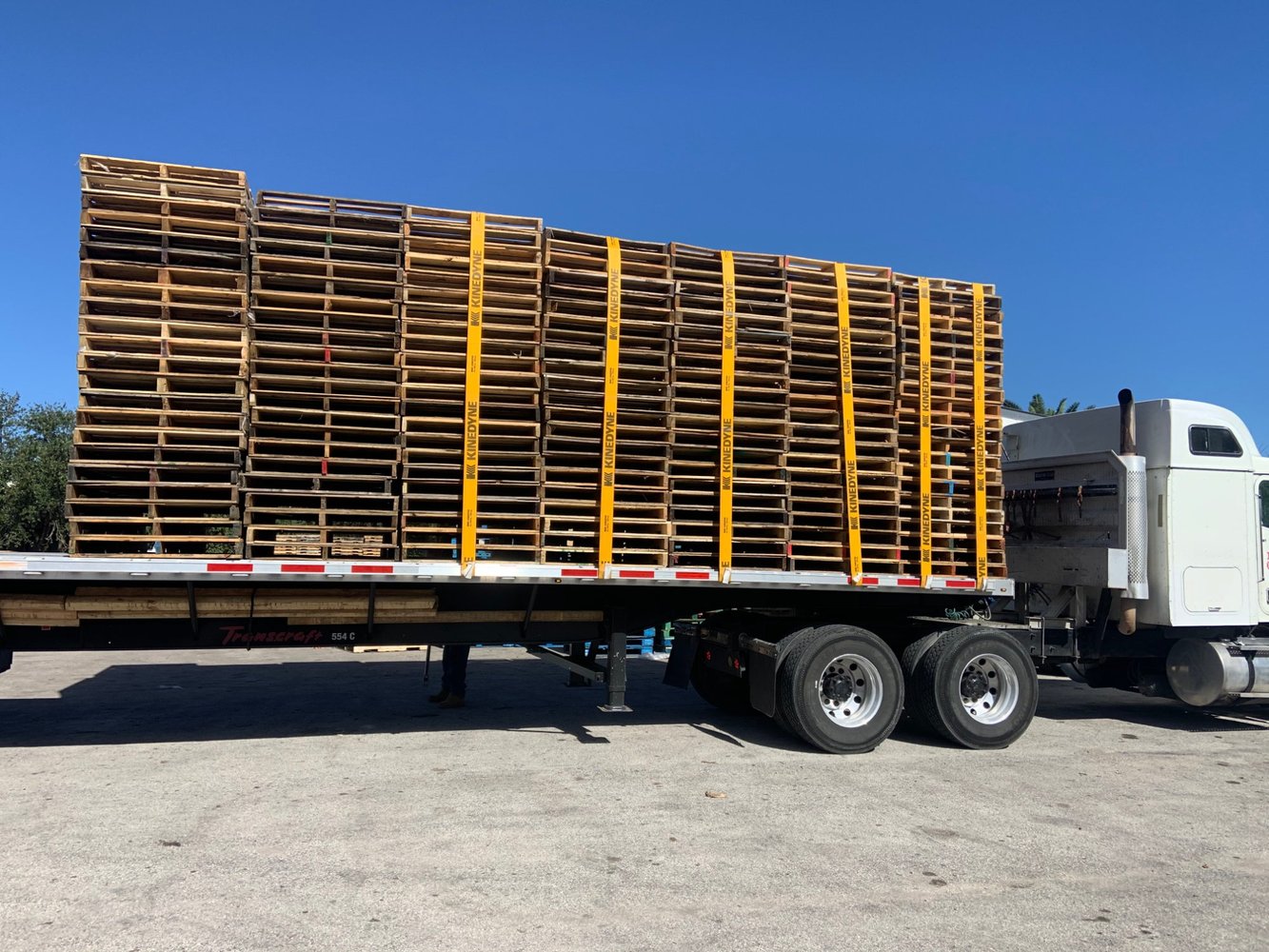
Whole Foods Market is among the most stringent retail buyers in the United States when it comes to supplier pallet compliance. Unlike conventional retailers where the primary concern is structural integrity, Whole Foods combines structural requirements with rigorous food safety standards, organic certification restrictions, and sustainability preferences - all of which affect what pallets are acceptable for delivering product to their distribution centers. Suppliers who miss these requirements face chargebacks, rejected loads, and potential loss of the account.
🍏 Need Whole Foods-compliant pallets in FL, GA, NJ, MD, or DE? We supply documented Grade A GMA pallets with food-grade certification letters for natural & organic retailers.
Get Compliant Pallets →Whole Foods Pallet Specification (2026)
Pallet Lumber & Sawmill Operations
Stamped kiln-dried pallet lumber, bulk warehouse stock, dimensional yard inventory, raw softwood logs, and sawmill operations - the supply chain behind every custom and standard pallet we ship.


| Requirement | Specification | Notes |
|---|---|---|
| Pallet dimensions | 48 x 40 inches (GMA standard) | Industry-standard footprint; no non-standard sizes accepted at most DCs |
| Pallet type | Stringer or block pallet | Block pallets preferred for heavier or premium product |
| Pallet grade | Grade A (near-new condition) | No broken boards, split stringers, missing blocks, or protruding nails |
| Wood treatment | Kiln-dried hardwood only | No chemical treatment permitted; no methyl bromide (MB) stamped pallets under any circumstances |
| Chemical contamination | Zero tolerance | Pallets must be odor-free and visually clean - Whole Foods DC staff will reject pallets with stains or residue |
| Pest evidence | Zero tolerance | Any sign of infestation (frass, exit holes, insect activity) results in immediate load rejection |
| Moisture content | < 19% | Wet pallets promote mold - critical for produce and organic suppliers |
| Pallet condition | Structurally sound | Must support full product load through multiple handling cycles without failure |
Organic and Natural Product Pallet Rules
For suppliers delivering USDA Certified Organic products or products marketed under Whole Foods' own organic standards, pallet requirements are even more restrictive:
- No chemically treated pallets: USDA National Organic Program (NOP) regulations under 7 CFR Part 205 prohibit the use of synthetic chemical treatments in organic handling operations. This means pallets that have been previously used to store or transport non-organic chemically treated products may be flagged as a contamination risk. Whole Foods organic suppliers should document the history of pallets used.
- Kiln-dried wood preferred: Heat treatment by kiln drying (KD) is an approved physical treatment under NOP. Pallets marked KD (kiln-dried) are acceptable for organic use. ISPM-15 heat-treated pallets (HT stamp) are also acceptable as the treatment is thermal, not chemical.
- No MB (methyl bromide) pallets: Methyl bromide is a prohibited substance under USDA NOP (it appears on the National List as a prohibited nonsynthetic). Any pallet bearing the MB stamp from historical fumigation treatment is disqualified for organic product delivery to Whole Foods.
- Pallet cleaning between cycles: For high-value organic or specialty products, Whole Foods may require documentation that pallets have been visually inspected and sanitized between use cycles. Food-grade sanitizers compatible with organic processing standards should be used.
- Plastic pallets increasingly required: For high-moisture organic products (cut fruit, fresh juice, fresh herbs), Whole Foods buyers may specify plastic pallets to eliminate wood contamination risk in the supply chain. Confirm requirements with your buyer before the first delivery.
Whole Foods DC Locations in Our Territory
Whole Foods operates regional distribution centers that serve stores in their geographic zone. Suppliers shipping into our five-state territory (FL, GA, NJ, MD, DE) typically route through one of these facilities:
| DC Location | States Served | Type | Key Notes |
|---|---|---|---|
| Landover, MD | MD, DC, VA, DE, southern NJ | Grocery + perishables | Nearest DC for Delaware and Maryland suppliers; organic requirements strictly enforced |
| South Brunswick, NJ | NJ, NY, CT | Full-service regional DC | Serves dense NJ/NY store network; high volume, fast turnaround required |
| Atlanta, GA | GA, TN, SC, AL | Grocery + perishables | Gateway for Southeast suppliers; GFSI audits required for most categories |
| Miami / Fort Lauderdale, FL | South FL | Perishables focused | High produce and tropical product volume; food-grade pallet requirements critical |
| Orlando / Central FL, FL | Central & North FL | Grocery + perishables | Growing market; serves rapidly expanding Central FL store base |
GFSI Certification and Pallet Compliance
Whole Foods Market requires most suppliers to hold a GFSI (Global Food Safety Initiative) recognized certification - typically SQF (Safe Quality Food), BRC Global Standard, or FSSC 22000. These certifications have specific pallet requirements embedded in their standards:
| GFSI Standard | Pallet Requirement | Documentation Needed |
|---|---|---|
| SQF Code (Edition 9) | Section 11.7.2: Packaging and pallet integrity; documented inspection program required | Pallet inspection log, supplier conformance letter |
| BRC Global Standard (Issue 9) | Section 4.12: Storage and distribution - pallets must be clean, maintained, inspected | Pallet specification, inspection records |
| FSSC 22000 | Based on ISO 22000 + PAS 223 - pallet as packaging material, documented control required | Supplier qualification letter, material spec |
| IFS Food (Version 7) | Section 4.12: Transport - pallets must not compromise product safety or quality | Pallet specification on file |
Whole Foods Chargeback Risks for Non-Compliant Pallets
Whole Foods Market enforces pallet compliance through chargebacks assessed against the supplier's account. Common chargeback triggers and typical costs:
| Violation | Typical Chargeback | Preventable By |
|---|---|---|
| Wrong pallet size (not 48x40) | $15 to $75 per pallet | Confirming pallet dimensions before loading |
| Grade below minimum (broken boards, etc.) | $15 to $75 per pallet | Inspecting pallets before loading product |
| MB-stamped pallet for organic product | Potential load rejection + product quarantine | Never using MB-stamped pallets for organic |
| Wet or moldy pallet | Load rejection; product loss at supplier's expense | Specifying dry pallets (<19% moisture) |
| Chemical contamination | Load rejection; potential account suspension | Verifying pallet provenance from known supplier |
Where the $15 to $75 comes from. That is the per-pallet chargeback band this guide already publishes above, and it applies to the two rows that are genuinely per-pallet defects: wrong footprint and below-minimum grade. The other three rows are deliberately left without a dollar figure because they are not per-pallet charges at all. An MB-stamped pallet under organic product, a wet or moldy pallet and a chemical contamination each put the whole load at risk, so the exposure is the value of the shipment plus the disposal and requalification cost, which is one to two orders of magnitude above a pallet chargeback. As of August 2026, treat the $15 to $75 as the floor of your compliance exposure and not the ceiling.
ⓘ Florida Pallet Supply can be more competitive for your area. Submit a free quote now →
⚠ Critical: Never Use MB-Stamped Pallets for Whole Foods
Methyl bromide (MB) fumigation is a historical pest treatment now phased out of most supply chains, but older pallets in circulation may still bear the MB stamp. Using an MB-stamped pallet for any organic product delivery to Whole Foods can trigger a full load rejection and potential product quarantine. Check every pallet before loading organic product and reject any bearing the MB stamp. Our supply chain uses only HT (heat treated) and KD (kiln dried) pallets - no MB stock.
Pre-Shipment Pallet Compliance Checklist
- Pallet dimensions confirm 48 x 40 inches - measure if uncertain
- All deck boards intact - no broken, cracked, or missing boards
- Stringers or blocks intact - no split stringers or missing blocks
- No protruding nails or staples above 1/4 inch
- Pallet is visually clean - no stains, residue, or chemical odor
- No MB stamp - check all four sides and bottom for old fumigation markings
- No pest evidence - no frass, exit holes, or insect activity
- Pallet is dry to the touch - no wet wood, no visible mold
- For organic product: pallet is from a documented clean source (our Grade A supply)
- Supplier conformance letter on file with your buyer
Frequently Asked Questions
Whole Foods does not universally mandate CHEP rental pallets the way some other retailers do for certain channels. Suppliers can use their own GMA Grade A pallets as long as they meet Whole Foods' specifications: 48x40 dimensions, Grade A condition, kiln-dried or heat-treated wood, no chemical contamination, no MB stamp, and free of pest evidence. Confirm requirements with your specific Whole Foods buyer, as regional DCs may have evolved local preferences.
Yes, recycled Grade A pallets are generally acceptable at Whole Foods DCs as long as they meet all specification requirements. 'Recycled' does not mean low-quality - Grade A recycled GMA pallets have been repaired to near-new condition, all broken boards replaced, nails re-set, and structural integrity verified. The key restrictions are: no MB-stamped pallets for organic product, no chemical contamination, and Grade A condition minimum.
Whole Foods buyers typically want to see a supplier conformance letter or Certificate of Conformance from your pallet supplier confirming: (1) pallet grade and species, (2) wood treatment type (KD or HT - never MB), (3) that pallets are free of chemical contamination, and (4) that pallets have been inspected before delivery. We provide these letters for qualifying customers. For GFSI-certified operations, include the pallet spec and supplier qualification in your GFSI documentation package.
Whole Foods does not universally mandate plastic pallets, but some buyers and DC managers prefer or require them for high-moisture fresh produce, fresh juice, or cut fruit deliveries where wood contamination risk is highest. Check with your buyer before the first delivery. If plastic is required, we stock food-grade nestable and rackable plastic pallets in the standard 48x40 footprint. Budget $55-90 per pallet versus $12-18 for Grade A wood.
Whole Foods DC receivers inspect incoming pallets at unloading. Non-compliant pallets (wrong size, damaged, contaminated, MB-stamped) can trigger pallet chargebacks ($15-75 per pallet) against your vendor account, or in serious cases (contamination, infestation), a full load rejection. If a load is rejected, you are responsible for pickup and product loss. Preventing rejection starts with inspecting every pallet before loading and sourcing from a documented Grade A supplier.