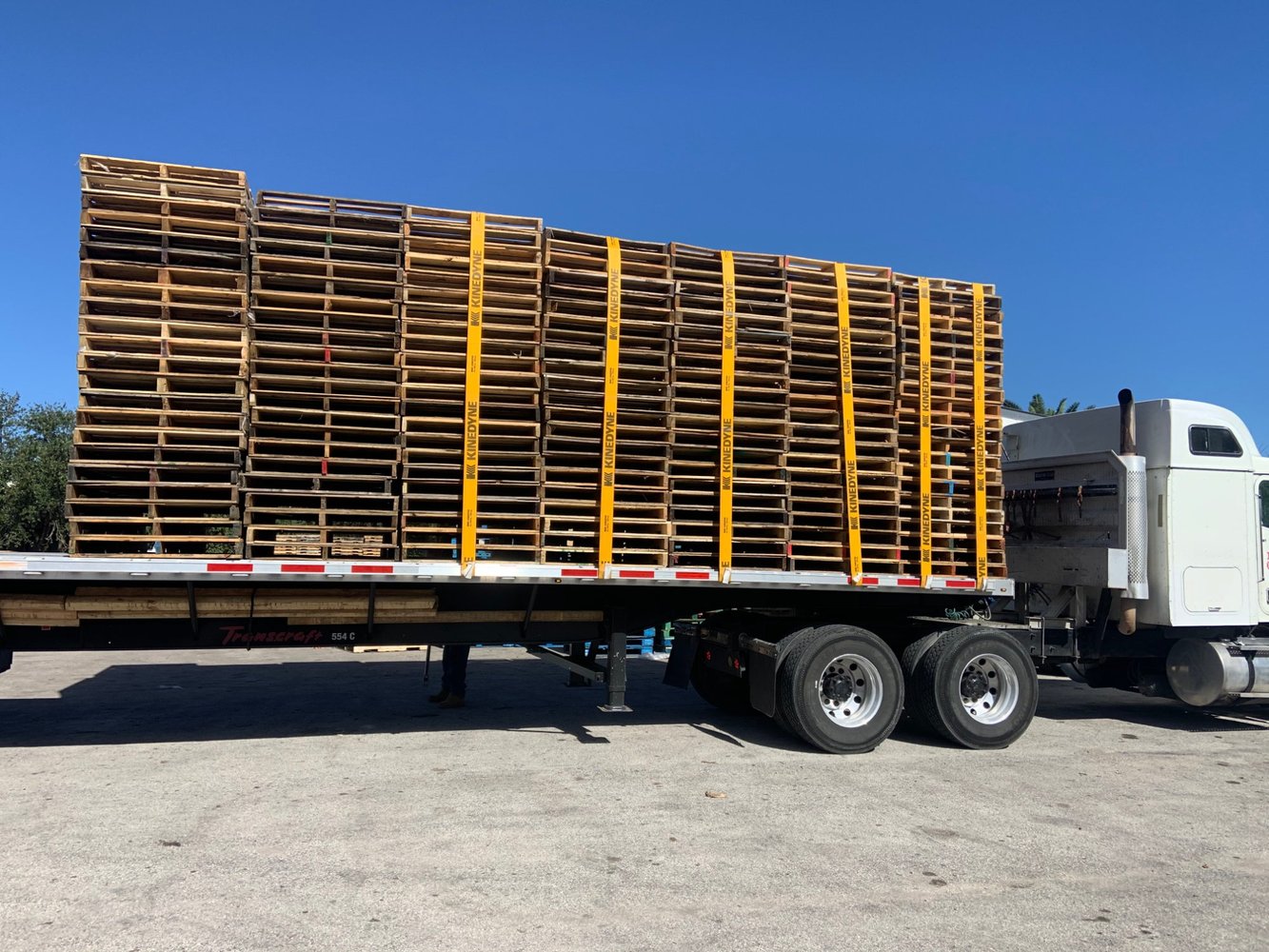
Pallets are one of the most expensive unmanaged assets in a typical warehouse operation. A facility using 2,000 pallets per week at $12 per Grade A recycled pallet, inside the $9 to $13 Florida range as of July 2026, has $24,000 of pallet inventory cycling through every week, yet most operations have no formal tracking system, no par levels, no cycle count process, and no pallet exchange policy. The predictable result: 20-30% annual pallet loss, $50,000-200,000 in uncontrolled pallet spend, and periodic shortages that stop production lines or delay outbound shipments. This guide provides the system for managing pallet inventory with the same rigor as finished goods inventory.
📦 Standing order programs lock pricing and ensure you never run short. Established accounts get same-week emergency fills. Set up your standing order with a 5-minute call.
Set Up Standing Order →Pallet Loss Rate Benchmarks by Operation Type
Pallet Lumber & Sawmill Operations
Stamped kiln-dried pallet lumber, bulk warehouse stock, dimensional yard inventory, raw softwood logs, and sawmill operations - the supply chain behind every custom and standard pallet we ship.


Pallet inventory management is the process of tracking, organizing, and replenishing pallet stock in a warehouse or distribution center to prevent production stoppages from pallet shortages. Effective pallet inventory management requires a minimum safety stock of 5 to 10 business days of consumption, a designated pallet storage zone with organized grade separation, a receiving inspection process to verify supplier-billed grades, and a reorder trigger system tied to consumption rate. Warehouses that do not actively manage pallet inventory face an average of 3 to 6 stockout events per year according to supply chain operations data.
| Operation Type | Low Loss (Well-Managed) | Average | High Loss (Unmanaged) |
|---|---|---|---|
| Manufacturing (closed loop) | 3-8% | 10-15% | 20-30% |
| Distribution Center (retail outbound) | 8-15% | 15-22% | 25-35% |
| 3PL / Fulfillment Center | 10-18% | 18-25% | 30-40% |
| Food & Beverage Production | 5-12% | 12-18% | 20-30% |
| E-commerce Fulfillment | 12-20% | 20-28% | 30-45% |
What Pallet Loss Actually Costs Per Year
Answer first: a distribution center moving 2,000 pallets a week at an average 18 percent loss rate is writing off about $224,640 a year in pallets. Getting that same operation to a well-managed 8 percent is worth roughly $274,560 a year against an unmanaged baseline. The loss-rate benchmarks above are the input; this is what they cost.
| Pallets per week | Pallets per year | Well managed (8%) | Average (18%) | Unmanaged (30%) | Unmanaged to well managed |
|---|---|---|---|---|---|
| 500 | 26,000 | $24,960 | $56,160 | $93,600 | $68,640 |
| 1,000 | 52,000 | $49,920 | $112,320 | $187,200 | $137,280 |
| 2,000 | 104,000 | $99,840 | $224,640 | $374,400 | $274,560 |
| 5,000 | 260,000 | $249,600 | $561,600 | $936,000 | $686,400 |
How these figures are calculated. Annual pallet flow multiplied by the loss rate multiplied by $12 per replacement pallet, which is the Grade A recycled price for Florida and Georgia as of July 2026 and sits inside the $9 to $13 range published on our pricing pages. The three loss rates are taken from the benchmark table earlier on this page, so the two agree. This is arithmetic on a single-turn assumption, not a survey result: it counts each pallet in the annual flow as exposed to loss once. Multi-turn closed-loop operations should model per-trip exposure instead, which pushes the numbers higher.
The reason this table matters more than the loss percentages on their own is that it makes the tracking-spend decision obvious. Barcode labeling at the top of the range, $0 per label, costs $26,000 a year to tag every pallet in a 2,000-per-week operation. The recoverable amount between unmanaged and well-managed at that same volume is $274,560. Labeling therefore costs under a tenth of what it is chasing, which is why the low-infrastructure option in the tracking table above usually pays back long before RFID is worth discussing.
The trap is the opposite case. At 500 pallets a week the same full-coverage labeling runs $6,500 a year against $68,640 of recoverable loss, so the ratio still works but the absolute saving is small enough that process discipline, a designated pallet zone and a dock-door count, will usually get most of the way there without buying a system at all.
The Five Sources of Pallet Loss
1. Outbound Pallets Not Returned (40-50% of loss)
The most common and most controllable loss source. Pallets leave with outbound shipments and the receiving DC, store, or end customer retains them. Fix: pallet exchange policy on all deliveries; contractual pallet return clause in carrier and customer agreements; charge-back unreturned pallets in your logistics contracts.
2. Pallet Taken by Receiving Facility (20-30%)
Receiving locations (retailers, DCs, customer facilities) regularly keep incoming pallets rather than returning them at delivery. Fix: mark all pallets with your company name or a bright painted mark; document pallets on the BOL; require delivery driver to collect return pallets.
3. Damage and Disposal (10-20%)
Pallets damaged in the facility (forklift accidents, overloaded racks, dropped product) and improperly disposed of rather than sent to repair. Fix: segregate damaged pallets for repair or buyback rather than dumpster; implement a damaged pallet repair program for Grade A to B downgrade management.
4. Internal Miscount / Misplacement (5-15%)
Pallets in the facility that aren't where they're supposed to be, hidden in corners, stacked behind product, or miscounted in physical inventory. Fix: WMS scanning for pallet in/out; monthly cycle count of all pallet storage locations; designated pallet storage areas.
5. Unauthorized Removal (1-5%)
Pallets removed from the facility by employees, contractors, or drivers without authorization. Fix: locked pallet storage area or visible camera coverage at dock doors; pallet markings that make unsanctioned removal more visible.
How to Calculate Your Optimal Pallet Par Level
Par level is the minimum quantity of pallets that must always be on hand to prevent operations from being disrupted by supply delays. The formula:
PAR LEVEL = (Daily Pallet Usage x Lead Time Days) + Safety Buffer
Example: A facility uses 150 pallets/day, supplier lead time is 2 days, and they want a 3-day safety buffer:
Par Level = (150 x 2) + (150 x 3) = 300 + 450 = 750 pallets minimum on hand
When inventory drops to par level, a replenishment order is triggered automatically. The safety buffer protects against demand spikes and supplier delays.
Pallet Tracking System Options
| System | Cost | Accuracy | Best For |
|---|---|---|---|
| Manual count (clipboard) | $0 (labor only) | 70-80% | Small operations (<200 pallets/week); starting point only |
| Spreadsheet tracking | $0 (labor only) | 75-85% | Small-medium operations; daily in/out tracking with discipline |
| WMS with pallet scan-in/out | $500-5,000/mo (WMS subscription) | 90-96% | Medium-large operations; integrates with inbound/outbound scanning |
| RFID pallet tracking | $3-8 per tag + reader infrastructure | 96-99% | Large operations; high-value pallet programs; automated door reads |
| Barcode label per pallet | $0.05 to $0.25 per label, plus a thermal printer | 88-95% | Good middle ground; scan at dock door in/out; low infrastructure cost |
| Pool tracking (CHEP LMS) | Included in CHEP fees | 95%+ | CHEP rental users; pool management system tracks all rental assets |
ⓘ Florida Pallet Supply can be more competitive for your area. Submit a free quote now →
WMS Pallet Management: Key Fields to Track
If your Warehouse Management System (WMS) tracks pallet inventory, configure these fields for effective pallet management:
- Pallet ID: Unique identifier (barcode or RFID tag); scan on receipt and at dock door on outbound
- Grade: A, B, or C; update when a pallet is downgraded due to damage
- Location: Storage bay, dock door, or staging zone
- Status: Available, in use (loaded), in queue for repair, in transport, returned/received
- In date: When the pallet was received into inventory (tracks age and cycle count)
- Out date: When the pallet left the facility (calculates open cycle, unreturned pallets)
- Carrier / customer: Which carrier or customer received the pallet (for return/exchange tracking)
Pallet Cycle Counting Program
Like finished goods cycle counting, pallet inventory benefits from regular physical count validation:
| Frequency | Method | Goal |
|---|---|---|
| Daily | Dock door scan-in/scan-out (automated or manual) | Real-time inventory accuracy; identify same-day discrepancies |
| Weekly | Physical count of pallet storage areas; compare to system | Catch location errors; find misplaced pallets; reconcile the week |
| Monthly | Full physical inventory of all pallets in facility + at customer locations | Validate total inventory; identify open cycles (pallets that left but haven't returned); reconcile loss vs. plan |
| Quarterly | Grade audit: physically inspect 10-20% sample of pallet inventory | Verify grade categorization is accurate; identify pallets that should be downgraded or sent to repair |
| Annually | Full inventory reconciliation; compare total pallets in vs. pallets out vs. current count | Calculate annual loss rate; set next year's loss reduction target; update par levels based on actual usage |
Standing Order Programs: The Best Pallet Inventory Tool
For operations using 100+ pallets per week, a standing order program eliminates the largest single source of pallet inventory problems: running out unexpectedly. A standing order with Florida Pallet Supply includes:
- Fixed delivery schedule (weekly, biweekly, or as needed), no purchase order required each cycle
- Price lock for the contract period, protection from market volatility during hurricane season or supply disruptions
- Priority allocation during supply tightness, standing order customers ship before spot order customers
- Same-week emergency fill capability, call before noon for same-week delivery on up to 2x normal order quantity
- Documented Grade A supply with conformance letter, ready for your food safety, pharmaceutical, or retailer compliance file
- Net-30 billing for qualified accounts, align pallet payments with your AR cycle
Frequently Asked Questions
The five highest-impact pallet loss reduction actions are: (1) Implement a pallet exchange or charge-back policy for all outbound deliveries, require return pallets or bill for non-returned pallets in your carrier contracts. (2) Mark all pallets with your company name or a bright paint mark, this discourages retention by receiving facilities. (3) Add pallets to your WMS with scan-in/scan-out at dock doors, visibility alone reduces loss by 20-30%. (4) Run monthly physical cycle counts comparing WMS count to physical count. (5) Establish a damaged pallet repair or buyback program, remove the dumpster disposal option that loses 100% of pallet value.
The industry average for distribution centers is 15-22% annual pallet loss. Well-managed operations with formal tracking programs achieve 8-15%. Poorly managed operations with no tracking can exceed 30%. For a DC using 1,000 pallets per week, the difference between 15% and 30% annual loss is approximately 7,800 pallets, at $12 per Grade A pallet, that is $93,600 per year in unnecessary pallet spend.
Your pallet par level should equal your daily usage rate multiplied by your supplier lead time, plus a safety buffer of 3-5 days of usage. For example, if you use 100 pallets per day and your supplier lead time is 2 business days, your par level is (100 x 2) + (100 x 3) = 500 pallets minimum on hand. When your inventory drops to par, trigger a replenishment order. A standing order program eliminates par level anxiety by delivering on a fixed schedule regardless of current inventory count.
Yes, for any operation using more than 200 pallets per week. WMS pallet tracking with scan-in/scan-out at dock doors reduces loss by 30-50% compared to manual tracking, because it creates visibility into which carrier or customer received each pallet, enabling charge-back and return requests. The investment in a WMS pallet module is typically recovered in reduced pallet replacement costs within 6-12 months for mid-to-large operations. Start simple: even a spreadsheet with daily dock door counts outperforms no tracking.
A standing order program eliminates the most common pallet inventory crisis, running out unexpectedly. With a fixed delivery schedule (weekly or biweekly), you receive pallets on a predictable cadence without needing to remember to reorder. Price locks protect you from market spikes during hurricane season or supply disruptions. Priority allocation means your order ships first during supply tightness. Emergency fill capability means you can double your normal order with a same-week phone call if demand spikes. Contact us to set up a standing order for your FL, GA, NJ, MD, or DE facility.