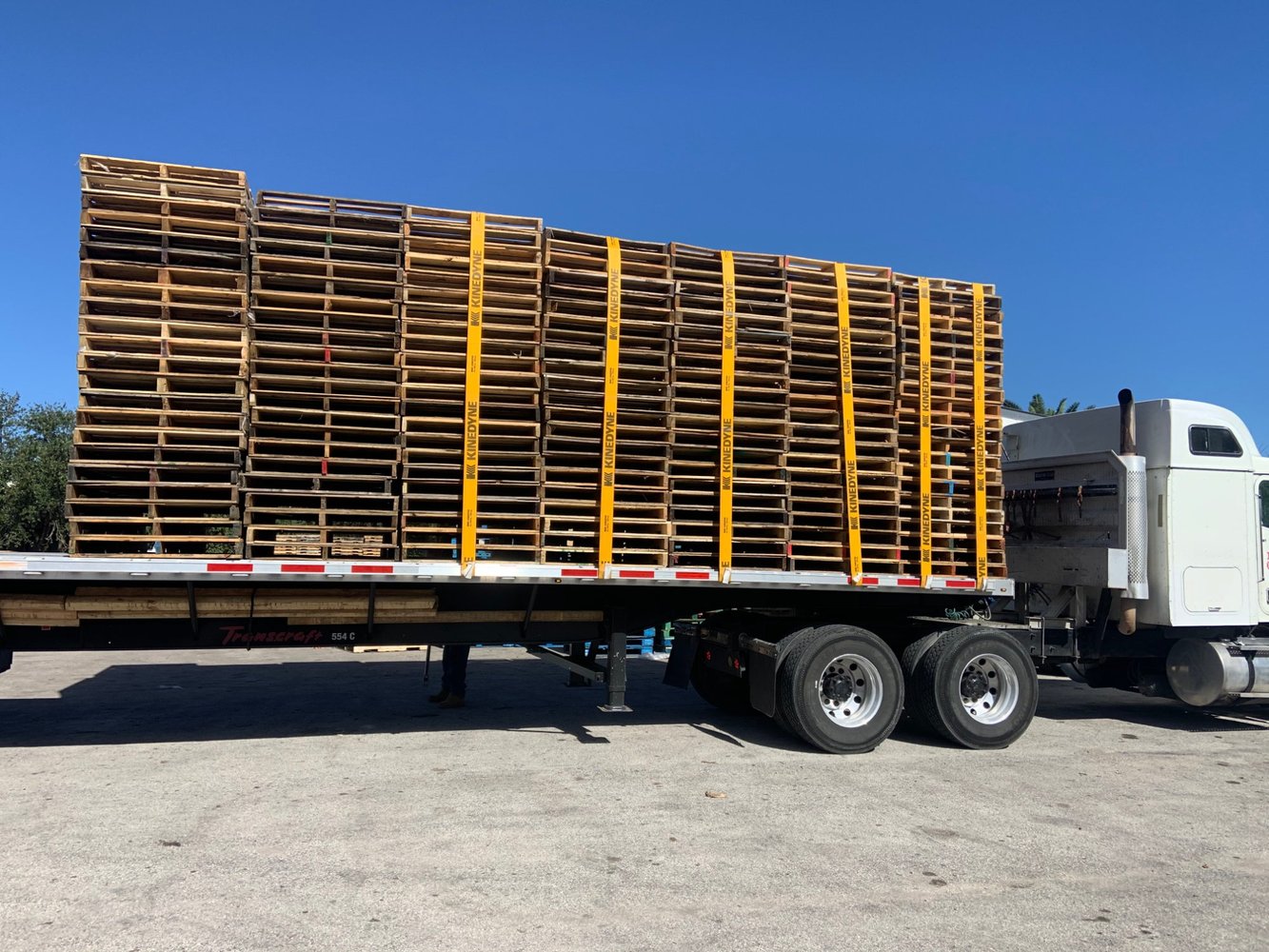
Sustainability has moved from a corporate PR initiative to a supply chain procurement requirement. Walmart's Project Gigaton, Amazon's Climate Pledge, Target's ESG commitments, and dozens of major CPG companies now require their supply chain partners to report and reduce environmental impact -- including packaging and pallet programs. Pallets represent a significant environmental variable: the US uses an estimated 2 billion pallets, consumes 40% of US hardwood lumber production, and generates millions of tons of broken pallet waste annually. Understanding the environmental lifecycle of pallets, and building a program that reduces waste and supports ESG reporting, is no longer optional for suppliers to major retailers.
♿ We buy back used pallets and offer pallet exchange programs across FL, GA, NJ, MD, and DE. Turn your surplus pallets into credit toward your next order.
Learn about buyback pricing →Wood Pallets: Environmental Lifecycle
Pallet Lumber & Sawmill Operations
Stamped kiln-dried pallet lumber, bulk warehouse stock, dimensional yard inventory, raw softwood logs, and sawmill operations - the supply chain behind every custom and standard pallet we ship.


Wood pallet recycling is the process of collecting used pallets, inspecting them, repairing broken boards and stringers, and returning them to circulation as Grade A, B, or C recycled pallets. Approximately 400 million wood pallets are recycled in the United States each year, diverting an estimated 20 million tons of wood waste from landfills. Recycled pallets carry a 40% to 60% lower carbon footprint than new pallets because they reuse existing lumber rather than requiring new timber harvest and milling.
- Carbon sequestration: A standard 48x40 GMA hardwood pallet contains approximately 0.5 cubic feet of hardwood lumber. Hardwood stores 1.1 lbs of CO2 per board foot of lumber -- each new pallet represents approximately 6-8 lbs of sequestered carbon captured from the atmosphere during tree growth.
- Recyclability: Over 95% of wood pallets can be repaired, remanufactured, or ground into mulch, biomass fuel, or composite materials. Virtually nothing from a wood pallet needs to go to landfill.
- Renewable material: US hardwood forests are sustainably managed -- more hardwood is grown than harvested each year. The pallet industry sources primarily from sustainably managed forests in the eastern US.
- Energy efficiency: Manufacturing a new wood pallet requires approximately 5-10 kWh of energy. Manufacturing a new plastic pallet requires 15-30 kWh. Recycling a wood pallet into a repaired Grade B requires less than 1 kWh.
- End-of-life: Wood pallets that cannot be repaired become animal bedding, mulch, compost, or biomass fuel -- all of which displace other resource-intensive products.
Wood vs. Plastic Pallets: Environmental Comparison
| Factor | Wood Pallet | Plastic Pallet |
|---|---|---|
| Material source | Renewable (sustainably managed US hardwood) | Non-renewable (HDPE/polypropylene from petroleum) |
| Manufacturing energy | 5-10 kWh per new pallet | 15-30 kWh per new pallet |
| Carbon footprint (new) | ~20-30 kg CO2e per pallet | ~40-60 kg CO2e per pallet |
| Lifespan (ambient use) | 3-5 years (Grade A to Grade C lifecycle) | 10-15 years |
| Lifespan per trip | 30-100 trips depending on application | 200-500 trips |
| Recyclability | 95%+ (repair, mulch, biomass, compost) | 90%+ (HDPE recycled into new plastic products) |
| End-of-life landfill | Biodegradable; low landfill risk | Non-biodegradable; higher landfill risk if not recycled |
| CO2 per trip (lifetime) | ~0.3-0.7 kg CO2e per trip (amortized) | ~0.1-0.3 kg CO2e per trip (amortized, longer life) |
Pallet Recycling Programs: How They Work
Pallet Repair & Regrade
Broken pallets are collected, inspected, and repaired: broken deck boards replaced, nails re-set, split stringers replaced. A repaired pallet moves from Grade C to Grade B or A. This is the most common recycling pathway for wood pallets and has a very low energy footprint compared to manufacturing new pallets.
Pallet Exchange Programs
A 1-for-1 exchange: when delivering pallets to a customer, you take back an equivalent number of used pallets from their yard. Both parties benefit -- the receiver clears yard space; the supplier gets a supply of recyclable pallets. We operate exchange programs for established accounts across all five states.
Buyback Programs
We purchase surplus used pallets directly from operations that have accumulated inventory. Grade A buyback: $6-10/pallet. Grade B: $3-6/pallet. Grade C: $0-2/pallet. Minimum pickup: typically 200 pallets. We handle logistics for accounts with 500+ pallets. See our sell used pallets guide for current pricing.
Biomass & Mulch End-of-Life
Pallets that are beyond repair (Grade C, broken beyond cost-effective repair) are ground into wood chips for biomass energy, landscape mulch, or animal bedding. This diverts pallet wood from landfill. Some operations sell wood chips to local biomass energy facilities or landscape suppliers for additional revenue per ton.
ESG Reporting: Pallet Metrics for Sustainability Reports
If your company reports under GRI, CDP, SASB, or any ESG framework, pallet-related metrics can contribute to your environmental performance reporting:
| ESG Metric | Pallet Data Point | How to Calculate |
|---|---|---|
| Scope 3 emissions | CO2e from pallet manufacturing and disposal | New pallets ordered x 25 kg CO2e average; pallets recycled x 0.5 kg CO2e end-of-life |
| Recycled material use | % of pallet spend on recycled (Grade B/A recycled) vs. new | Track new vs. recycled orders; report as % of total pallet spend |
| Waste diversion | Pallets recycled, repaired, or exchanged vs. landfilled | Count pallets entering buyback or exchange program vs. disposed in general waste |
| Supplier sustainability | Pallet supplier's environmental practices | Request FSC chain-of-custody certification letter; document in supplier qualification |
| Packaging reduction | Pallet weight and material reduction over time | Track average pallet empty weight per quarter; any reduction counts toward packaging lightweighting goals |
Retail Sustainability Requirements Affecting Pallet Choice
| Retailer Program | Pallet Relevance | What Suppliers Should Do |
|---|---|---|
| Walmart Project Gigaton | Scope 3 supplier emissions reduction; packaging sustainability | Prioritize recycled Grade A pallets over new; document recycled pallet percentage |
| Amazon Climate Pledge | Net-zero carbon by 2040; packaging reduction | Use recycled pallets where spec allows; track and report pallet CO2e to Amazon as part of supplier ESG data |
| Target ESG 2030 | 100% sustainable packaging by 2025 (extended to 2030) | Document pallet wood source (sustainably managed forest); prefer recycled over new |
| Whole Foods Sourcing Standards | Natural and organic suppliers expected to use sustainable materials | Source from certified sustainable wood suppliers; avoid plastic pallets unless food safety requires |
| IKEA Sustainability | Circular supply chain preference; IWAY supplier standards | Document pallet recycling program; show 95%+ wood pallet diversion from landfill |
How to Build a Sustainable Pallet Program
- Audit your current usage: Count total pallets purchased annually, split between new and recycled. Calculate estimated CO2e for your baseline report.
- Shift to recycled Grade A where spec allows: Most domestic distribution applications can use Grade A recycled pallets instead of new without compliance risk. New pallets should be reserved for applications where new wood is required (some pharma GDP, Costco display floor).
- Implement a pallet exchange or buyback program: Zero pallets should go to landfill. Damaged pallets should enter a repair, buyback, or biomass stream. Contact us to set up an exchange or buyback program for your facility.
- Track pallet metrics quarterly: Pallets purchased, pallets recycled/exchanged, pallets disposed. These numbers feed your Scope 3 and waste diversion ESG metrics.
- Request sustainability documentation from your supplier: Ask for wood source certification (sustainably managed forest statement), recycled content percentage, and end-of-life diversion rates. We provide these for qualifying accounts.
- Report to retailer sustainability portals: Walmart's Supplier Sustainability Assessment, Amazon's Sustainability Reporting Portal, and Target's supplier ESG questionnaires all have questions about packaging materials that can include pallets.
Frequently Asked Questions
Yes -- wood pallets are one of the more sustainable packaging materials in the supply chain when properly managed. US hardwood forests grow more wood than is harvested each year. Wood pallets sequester carbon captured during tree growth (approximately 6-8 lbs of CO2 per GMA pallet). Over 95% of wood pallets can be repaired, remanufactured into lower-grade service, ground into mulch or biomass, or composted -- virtually nothing needs to go to landfill. Compared to plastic pallets (petroleum-derived, higher manufacturing energy, non-biodegradable), wood pallets have a better lifecycle environmental profile in most applications.
A pallet buyback program is when a pallet supplier purchases used pallets from an operation that has surplus inventory. We pay $6-10 for Grade A GMA pallets, $3-6 for Grade B, and $0-2 for Grade C. Minimum pickup is typically 200 pallets; we handle logistics for orders of 500+ pallets. The pallets we buy back are inspected, repaired as needed, and returned to service -- keeping them out of landfill and reducing the total manufacturing demand for new pallets. Buyback pricing varies by grade, condition, and current market; contact us for a current quote.
Yes. Pallet recycling can contribute to multiple ESG reporting metrics: waste diversion from landfill (pallets repaired or ground into biomass vs. disposed), Scope 3 emissions reduction (recycled pallets have significantly lower manufacturing CO2e than new pallets), sustainable sourcing (documenting that wood pallets come from sustainably managed forests), and circular economy initiatives (pallet exchange programs as an example of circular supply chain practice). Check the specific framework you report under (GRI, CDP, SASB) for the relevant metric categories.
FSC (Forest Stewardship Council) chain-of-custody certification is not universally required for pallet sustainability claims, but it is the strongest documentation available. FSC certification verifies that the wood in a pallet comes from a responsibly managed forest. For suppliers responding to Walmart's Project Gigaton, Amazon's Climate Pledge, or Target's sustainable packaging program, FSC certification provides the strongest supplier qualification. Non-FSC certified but sustainably managed wood is also acceptable with documentation -- we can provide a statement on wood sourcing practices for qualifying orders.
A new GMA 48x40 hardwood pallet in typical grocery and consumer goods distribution can last 30-100 trips before requiring significant repair or retirement. Grade A pallets that have been through 20-30 trips may be graded down to Grade B; Grade B pallets after another 20-30 trips may become Grade C. Grade C pallets can be repaired and brought back to Grade B service or retired to biomass/mulch. The entire useful life of a single pallet -- across multiple grades and repair cycles -- can span 3-7 years in ambient conditions, during which it replaces the need to manufacture additional pallets.