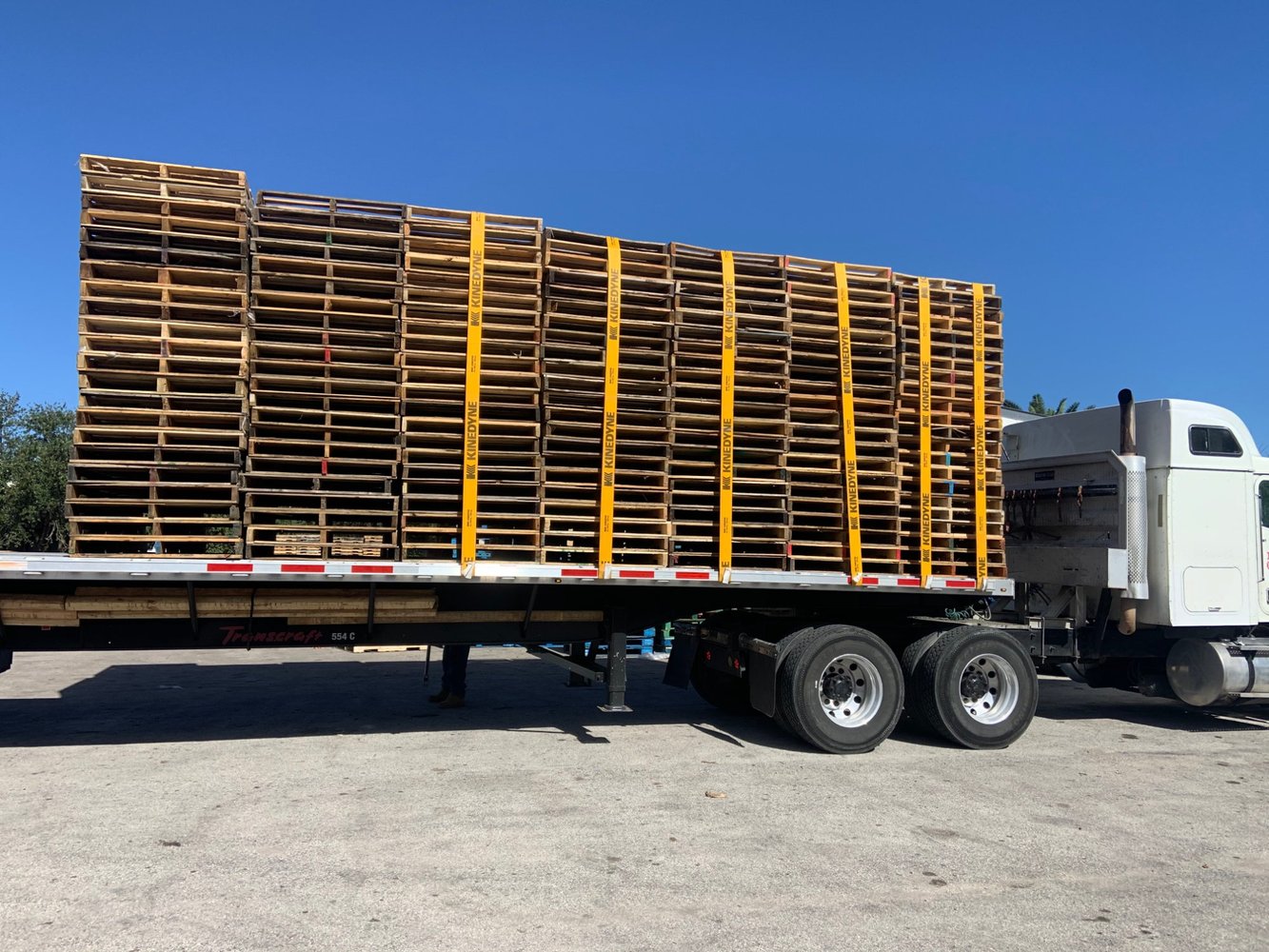
Third-party logistics providers (3PLs) and fulfillment centers face a unique pallet challenge: they handle products for multiple clients, each with different retailer compliance requirements, different load weights, and different pallet preferences - and they need to manage pallet inventory, losses, and program costs across all of them simultaneously. The right pallet program can reduce per-unit costs, eliminate retailer chargebacks, and give operations managers one less variable to worry about. The wrong one bleeds pallets out the dock door at $8-15 each.
📨 We supply pallets to 3PLs and fulfillment centers across FL, GA, NJ, MD, and DE - truckload pricing, standing orders, and documented Grade A stock for retailer compliance.
Get 3PL Quote →The Three Pallet Program Models for 3PLs
Pallet Lumber & Sawmill Operations
Stamped kiln-dried pallet lumber, bulk warehouse stock, dimensional yard inventory, raw softwood logs, and sawmill operations - the supply chain behind every custom and standard pallet we ship.


Every 3PL operation runs on one of three foundational pallet models, or a hybrid of them. Understanding the strengths and weaknesses of each is the starting point for cost control:
Model 1: Pallet Purchase (Ownership)
The 3PL buys pallets outright and manages its own inventory. Lowest per-unit cost ($7-18 for Grade A recycled GMA) and maximum flexibility. The challenge is pallet tracking - pallets leave with outbound shipments and may not return. Best for operations where most outbound shipments are intra-network (pallets stay internal) or where clients provide their own pallets for inbound.
Model 2: Pallet Rental Pool (CHEP/PECO)
3PL rents pallets from a national pool, typically CHEP (blue pallets) or PECO (red pallets). Convenient for operations serving major retailers that mandate rental pools. However, rental pallets come with significant ongoing costs: issue fees ($2.00 to $2.50 per pallet), rental fees ($0.35 to $0.45 per pallet per month), and transfer fees whenever pallets move between locations. Annual cost for a 1,000-pallet operating inventory can exceed $80,000-110,000 per year.
Model 3: Pallet Exchange
The 3PL exchanges pallets at delivery: inbound loads arrive on client-owned pallets, which are exchanged for equivalent pallets from the 3PL's inventory upon unloading. This model works well when pallet grades match, but creates friction when client pallets arrive in poor condition. A documented pallet exchange policy with condition criteria prevents disputes and chargebacks.
Annual Cost Comparison: Purchase vs. CHEP Rental (1,000 Pallet Operating Inventory)
| Cost Component | Purchase (Grade A Recycled) | CHEP Rental | Notes |
|---|---|---|---|
| Initial acquisition | $10,000 - $15,000 | $0 | One-time purchase vs. deposit only |
| Annual issue fees | $0 | $18,000 - $30,000 | CHEP charges about $2.00 to $2.50 per issue |
| Annual rental fees | $0 | $3,000 - $5,400 | $0.35 to $0.45 per pallet per month |
| Annual transfer fees | $0 | $2,000 - $4,000 | Inter-company pallet transfers |
| Pallet loss/replacement (15%) | $1,500 - $2,250 | $6,000 - $12,000 | CHEP loss fees are significantly higher |
| Repair / maintenance | $500 - $1,000 | $0 (CHEP manages) | Minor board replacement |
| Total Annual Cost | $2,000 - $3,250 | $29,000 - $51,400 | Excludes initial acquisition |
ⓘ Florida Pallet Supply can be more competitive for your area. Submit a free quote now →
Note: CHEP rental is the right choice for operations where most retail customers mandate rental pool pallets (Walmart, Costco, etc.). For mixed retail or direct industrial shipping, owned pallets are almost always the lower total cost.
Retailer Pallet Requirements That Affect 3PL Operations
When a 3PL ships to major retail distribution centers on behalf of clients, the 3PL becomes responsible for pallet compliance even though the product belongs to the client. Chargebacks for non-compliant pallets hit the 3PL's account unless contractually passed through. Key requirements:
| Retailer | Pallet Spec | Grade Requirement | Rental Pool Required? |
|---|---|---|---|
| Walmart / Sam's Club | GMA 48x40 | Grade A | No (own pallets accepted if compliant) |
| Amazon FBA | GMA 48x40 or 40x48 | Grade A | No (specific forklift-entry requirements) |
| Costco | GMA 48x40 | Grade A, new preferred for display items | CHEP preferred at some DCs |
| Target | GMA 48x40 | Grade A | No (own pallets accepted) |
| Kroger / Harris Teeter | GMA 48x40 | Grade A | No |
| Publix | GMA 48x40 | Grade A, food-grade wood | No |
| Home Depot / Lowe's | GMA 48x40 or custom | Grade A or B | No (CHEP welcome) |
E-Commerce Fulfillment Pallet Needs
E-commerce fulfillment centers run different pallet requirements than traditional retail distribution. The high SKU count, smaller average order weight, and rapid inventory turnover create a different demand profile:
- Lower average pallet weights: Mixed-SKU e-commerce pallets typically run 300-1,200 lbs rather than the 2,000-2,800 lbs of retail-ready cases. This means Grade B pallets are often structurally adequate for inbound receiving and internal staging - reserving Grade A for outbound retail-compliant shipments.
- Higher pallet turnover: Fast-moving e-commerce facilities may turn pallet inventory 3-5 times per week. This increases wear and loss rates - budget for 20-25% annual replacement rather than the 15% typical for slower operations.
- Automation compatibility: Automated fulfillment systems (Kiva, Autostore, conveyor systems) often require specific pallet dimensions, consistent deck board spacing, and no protruding nails or uneven surfaces. Check automation specs before ordering and specify consistently-built new or Grade A pallets.
- Returns handling: E-commerce returns create inbound volume on random pallets. A documented policy for accepting, inspecting, and segregating returned-product pallets prevents poor-quality inbound pallets from entering the outbound pool.
Pallet Loss Management for 3PLs
Pallet loss is the largest controllable variable in 3PL pallet program costs. The average operation loses 15-20% of pallet inventory annually. High-loss operations exceed 30%. The primary causes and remedies:
| Loss Cause | % of Total Loss | Remedy |
|---|---|---|
| Outbound shipments - pallets not returned | 40-50% | Pallet exchange policy at delivery; charge-back non-returned pallets in client contracts |
| Pallet used by receiving facility | 20-30% | Mark pallets with company logo or unique color; document in BOL |
| Damage / disposal at client or DC | 10-20% | Send Grade A to retail DCs; reserve Grade B for internal or non-retail moves |
| Internal miscount / misplacement | 5-15% | Scan pallets into/out of WMS; monthly cycle count of pallet inventory |
| Theft / unauthorized removal | 1-5% | Locked pallet storage area; camera coverage at dock doors |
Standing Order Programs for High-Volume 3PLs
High-volume 3PLs benefit from standing pallet supply agreements rather than spot purchasing. A standing order program with Florida Pallet Supply provides:
- Committed weekly or biweekly delivery on a fixed schedule - no lead time anxiety
- Locked pricing for the contract term - protection from market fluctuations
- Priority allocation during supply disruptions (hurricane season, port congestion)
- Documented Grade A certification letter for retailer compliance files
- Credit account and net-30 billing for qualified customers
- Same-week emergency fills for volume spikes beyond standing order quantity
3PL Markets We Serve
We supply pallets to 3PL and fulfillment operations across all five states in our territory. Key 3PL corridors:
| State | Key 3PL / Fulfillment Markets | Primary Demand |
|---|---|---|
| Florida | Orlando, Tampa, Miami, Jacksonville, Lakeland | E-commerce, food dist., tourism supply chain |
| Georgia | Atlanta (largest 3PL hub in Southeast), Savannah | Retail DC, e-commerce, port logistics |
| New Jersey | Elizabeth, Edison, Linden, Secaucus, Piscataway | Port import distribution, pharma, e-commerce |
| Maryland | Baltimore, Hagerstown, Jessup | Retail DC, cold chain, government logistics |
| Delaware | New Castle, Wilmington, Middletown | Pharma, produce distribution, industrial |
How Many Pallets Should a 3PL Keep On Hand?
The most common 3PL pallet-planning question is buffer sizing: how much owned inventory covers your outbound volume without tying up cash or dock space. The guidance below sizes on-hand buffer at roughly twice weekly throughput to absorb replenishment lead time and demand variability (typical planning figures as of July 2026; tune to your actual lead time and seasonality).
| Weekly pallets shipped | Recommended on-hand buffer | Reorder trigger | Replenishment cadence |
|---|---|---|---|
| 250 | ~500 | 300 on hand | Weekly delivery |
| 500 | ~1,000 | 600 on hand | Weekly delivery |
| 1,000 | ~2,000 | 1,200 on hand | Twice weekly |
| 2,500 | ~5,000 | 3,000 on hand | Twice to three times weekly or standing order |
| 5,000 | ~10,000 | 6,000 on hand | Standing truckload program |
Frequently Asked Questions
Grade A (near-new condition, no broken boards, no split stringers, no protruding nails) is the standard requirement for outbound shipments to major retail distribution centers including Walmart, Amazon FBA, Target, Kroger, Publix, and Costco. Most retailer vendor guides specify 'GMA Grade A' explicitly. Using Grade B for outbound retail shipments risks chargeback fees of $15-50 per pallet depending on the retailer. Reserve Grade B for internal staging and non-retail outbound shipments.
For most 3PL operations, purchasing Grade A recycled pallets is significantly cheaper than CHEP rental over a 12-month horizon. The total annual cost of owned pallets for a 1,000-pallet operating inventory runs $2,000-3,250 (replacement + maintenance), compared to $29,000-51,400 for CHEP rental. CHEP rental makes sense when a specific client mandates CHEP pallets for their retail channel and the cost can be passed through in the service agreement. Run the numbers client by client rather than applying one program across all accounts.
Best practice is a two-pool system: a Grade A pool for all outbound retail-compliant shipments, and a Grade B/C pool for internal staging, non-retail outbound, and receiving operations. Document the Grade A pool with a supplier conformance letter for your compliance files. Train receiving dock staff to inspect inbound pallets on arrival and segregate damaged pallets immediately - do not let Grade C pallets migrate into the Grade A pool.
Industry benchmarks put average pallet loss at 15-20% annually for well-managed operations. Poor performers can exceed 30%. The primary driver is outbound pallets not being returned - they leave with your shipment and the receiving DC or end customer keeps them. Reducing loss starts with a contractual pallet exchange or return policy in your client and carrier agreements, marking pallets with your company name or a unique identifier, and scanning pallets in and out of your WMS.
Yes. We set up standing order programs for fulfillment centers and 3PLs that need predictable weekly or biweekly pallet delivery. Standing orders include locked pricing, a dedicated delivery schedule, and priority allocation during supply crunches. Contact us to discuss volume, delivery frequency, and preferred grades - we serve all major 3PL corridors in FL, GA, NJ, MD, and DE.