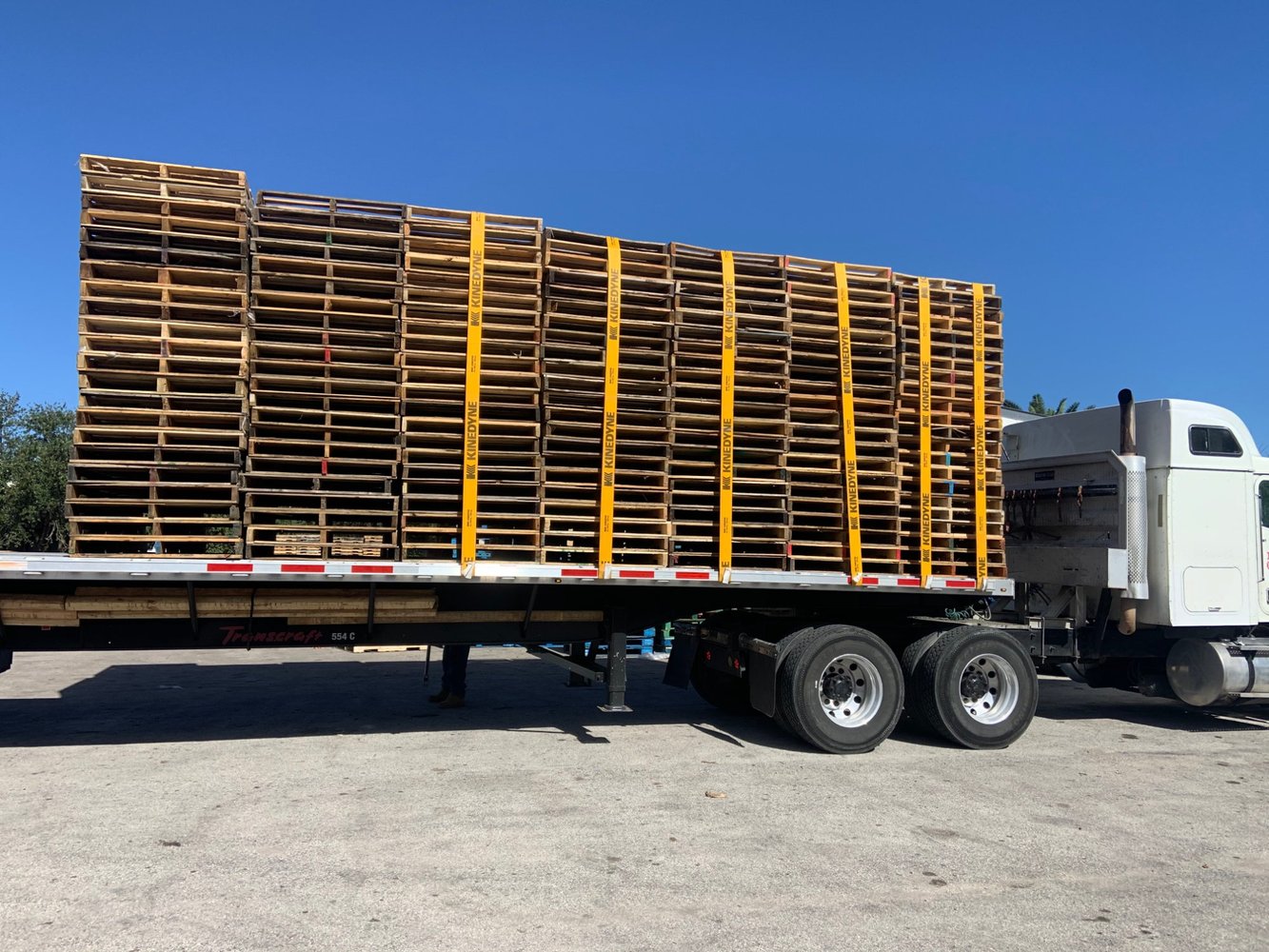
The term "food grade pallet" is used widely in the food industry but is not defined by a single regulatory standard. Instead, it refers to pallets that meet a combination of FDA, FSMA, USDA, and GFSI certification requirements that collectively ensure pallets do not contaminate food products. Understanding exactly what "food grade" means in each regulatory context -- and what documentation your auditor will expect -- is essential for food manufacturers, distributors, packinghouses, and 3PLs operating in regulated food supply chains.
🍔 Food-grade certified pallets with conformance letters for FDA, FSMA, SQF, BRC, and USDA Organic compliance. Delivered across FL, GA, NJ, MD, and DE.
Get Food-Grade Quote →What "Food Grade" Actually Means by Standard
Pallet Lumber & Sawmill Operations
Stamped kiln-dried pallet lumber, bulk warehouse stock, dimensional yard inventory, raw softwood logs, and sawmill operations - the supply chain behind every custom and standard pallet we ship.


| Standard | Governing Body | Pallet Requirement | Documentation Needed |
|---|---|---|---|
| FSMA / HARPC | FDA (21 CFR Part 1) | Pallets must be identified as a hazard control point; inspection program documented in HARPC plan | HARPC plan with pallet section; inspection log |
| SQF Code (Edition 9) | SQF Institute / SQFI | Section 11.7.2: pallet integrity and cleanliness documented; inspection program required | Pallet inspection SOP; supplier conformance letter |
| BRC Global Standard (Issue 9) | BRCGS | Section 4.12: pallets clean, maintained, sourced from known suppliers; no pallets from unknown sources in food contact zones | Supplier qualification; inspection records |
| FSSC 22000 | Foundation FSSC | ISO 22000 + PAS 223: pallet as packaging material; documented control required | Material specification; supplier qualification |
| USDA NOP (Organic) | USDA AMS | No synthetic chemical treatment; no MB-fumigated pallets; KD or HT treatment acceptable | Treatment type declaration from supplier |
| USDA AMS (Inspected facilities) | USDA AMS | Pallets free of pest evidence, contamination, and structural damage at point of use | Inspection log; damaged pallet removal policy |
FDA FSMA and Food-Grade Pallets: What HARPC Requires
The FDA's Food Safety Modernization Act (FSMA) requires most food facilities to implement a Hazard Analysis and Risk-Based Preventive Controls (HARPC) plan. Pallets are specifically identified in FDA guidance as a potential physical and chemical hazard in food handling environments. Your HARPC plan must:
- Identify pallets as a hazard: Physical hazards (wood splinters, protruding nails, broken boards) and chemical hazards (residue from previous chemical cargo, MB fumigation) must be identified in your hazard analysis.
- Implement a preventive control: A documented pallet inspection program is the standard preventive control. This typically includes visual inspection before use, rejection criteria, and a damaged pallet removal procedure.
- Document the control: Inspection records must be maintained. The FDA recommends at minimum a daily pallet inspection log signed by an authorized employee.
- Validate the control: During an FDA inspection, you must be able to demonstrate that your pallet inspection program is functioning as written. This includes showing sample inspection logs and demonstrating the rejection/removal process.
- Supplier qualification: FSMA also encourages (and GFSI standards require) qualification of pallet suppliers. A supplier conformance letter from your pallet supplier is the minimum document expected.
Food-Grade Pallet Inspection Criteria
| Inspection Point | Food-Grade Standard | Action on Failure |
|---|---|---|
| Top deck boards | All intact; no broken, cracked, or missing boards; consistent spacing | Remove from food contact service; downgrade or discard |
| Bottom deck boards | Intact; no damage that compromises stability | Assess structural integrity; remove if compromised |
| Stringers / blocks | No splits, breaks, or missing blocks; no previous repairs with non-food-safe materials | Remove from service immediately |
| Nails / fasteners | Flush or recessed; no protrusion above deck surface | Re-drive or replace; remove pallet if nail is missing |
| Chemical contamination | No stains, residue, or odor suggesting chemical contact; no MB stamp | Remove permanently; do not use in food operations |
| Pest evidence | No frass (insect excrement), exit holes, insect activity, or rodent evidence | Remove permanently; notify facility manager; check adjacent pallets |
| Mold / moisture | Dry to touch; no visible mold; moisture content below 19% | Quarantine wet pallets; dry before use or discard if moldy |
| Foreign material | No product residue, labels, or foreign objects from previous use | Clean or discard depending on contamination type |
MB (Methyl Bromide) Pallets: The Non-Negotiable Rejection
Methyl bromide is a broad-spectrum pesticide fumigant that was historically used to treat wooden pallets and packaging for pest control. It is now phased out under the Montreal Protocol for most uses and is explicitly prohibited under USDA's National Organic Program (7 CFR Part 205). Any pallet bearing the MB stamp must be:
- Permanently excluded from food contact areas (by any GFSI standard or FDA FSMA-compliant operation)
- Never used for organic products under any circumstances (USDA NOP prohibition)
- Not re-exported with food products to countries that ban MB-treated materials (EU has strict restrictions)
Our pallet supply uses only HT (heat treated, ISPM-15) and KD (kiln dried) treatment -- never MB fumigation. We provide written certification of treatment type with every order for food operations.
GFSI Certification and Pallet Documentation Requirements
SQF Edition 9
Section 11.7.2 requires documented pallet integrity management: inspection SOP, rejection criteria, and inspection records. Annual supplier qualification review. Auditors look for both the written procedure and evidence it's being followed (filled-in inspection logs, dated and signed).
BRC Issue 9
Section 4.12 prohibits pallets from unknown sources in food contact zones. Requires supplier qualification documents (conformance letter at minimum). Auditors check whether pallets are inspected before use and whether damaged pallets are removed from the food area promptly.
FSSC 22000
Treats pallets as a packaging material under PAS 223. Requires documented material specification (dimensions, grade, treatment type, species) and evidence of supplier qualification. Can be part of the facility's broader material approval program.
IFS Food 7
Section 4.12 (transport and packing): pallets must not compromise product safety or quality. European customers with IFS-certified suppliers expect documented pallet specifications as part of the supply chain food safety file.
Wood vs. Plastic for Food-Grade Applications
| Factor | Wood (Grade A) | Plastic (Food Grade) |
|---|---|---|
| Initial cost | $11-18 per pallet | $52-120 per pallet |
| FDA acceptability | Acceptable with inspection program | Preferred for direct food contact |
| SQF / BRC acceptability | Yes, with documented program | Yes (preferred for RTE areas) |
| USDA Organic acceptability | Yes (KD or HT, no MB) | Yes (food-grade plastic approved) |
| Splinter / nail risk | Present (mitigated by Grade A and inspection) | None |
| Sanitation (wash/sanitize) | Limited (porous; not pressure washable) | Excellent (non-porous; pressure washable) |
| Cold chain performance | Good above 32F; limited below 32F | Excellent from -40F to +275F |
| Lifespan | 2-5 years in food applications | 8-15 years |
ⓘ Florida Pallet Supply can be more competitive for your area. Submit a free quote now →
Documentation Package for Food Safety Audits
When a SQF, BRC, FSMA, or FDA audit occurs, your auditor will request documentation related to pallet management. The standard documentation package should include:
- Pallet Supplier Conformance Letter (grade, species, treatment type -- no MB)
- Pallet Material Specification (dimensions, construction type, treatment mark)
- Pallet Inspection SOP (written procedure with frequency, criteria, and rejection protocol)
- Pallet Inspection Log (completed daily or per-shift; signed by authorized employee)
- Damaged Pallet Removal Records (log of pallets removed from service with date and reason)
- Pallet Supplier Qualification Record (annual review; copy of supplier's conformance letter)
- HARPC/HACCP Reference (section identifying pallets as a controlled hazard and the control measure)
We provide the Supplier Conformance Letter and Material Specification for all food-grade orders. Contact us to request your documents -- we issue them within 24 hours of order confirmation.
Frequently Asked Questions
There is no single official 'food grade' pallet certification. In practice, a food grade pallet is one that meets the cumulative requirements of the regulatory standards your facility operates under: FDA FSMA (inspected, no contamination, part of HARPC plan), GFSI standards like SQF or BRC (documented inspection program, known supplier), and USDA NOP for organic (no MB fumigation, no synthetic chemical treatment). At minimum, a food grade pallet must be: Grade A condition, made from kiln-dried or heat-treated wood (never MB fumigated), free of chemical contamination and stains, dry, pest-free, and from a documented supplier.
Yes, recycled pallets can be used in food facilities with proper controls. Grade A recycled GMA pallets that pass visual inspection -- no broken boards, no contamination, no MB stamp, no pest evidence, dry -- are acceptable under FDA FSMA, SQF, BRC, and FSSC 22000 when sourced from a documented supplier and inspected before use. Grade B and C pallets should not be used in food contact areas. For ready-to-eat product zones, plastic pallets are preferred because they eliminate wood contamination risk entirely.
Not always -- plastic pallets are preferred but not universally required by SQF, BRC, or FSSC 22000. These standards require documented pallet management programs and pallet integrity, which can be met with Grade A wood pallets and a rigorous inspection program. However, some GFSI standard requirements for ready-to-eat (RTE) product areas and open product contact zones strongly imply plastic is the only practical choice because wood cannot be adequately sanitized. Review your specific GFSI standard section on packaging and materials with your food safety consultant.
FDA FSMA (21 CFR Part 1, Subpart C -- HARPC) requires food facilities to identify all hazards in their process, including physical hazards (wood splinters, nails) and chemical hazards (pallet contamination). Pallets must be addressed in the hazard analysis section of your HARPC plan, with a documented preventive control (pallet inspection program), monitoring records (inspection logs), and corrective actions (damaged pallet removal). FDA inspectors look for completed inspection logs, reject/removal procedures, and evidence of supplier qualification during food facility inspections.
Yes. USDA National Organic Program (NOP) regulations under 7 CFR Part 205 prohibit the use of synthetic chemical treatments in organic handling operations. This means pallets treated with methyl bromide (MB) -- a synthetic fumigant -- cannot be used for certified organic product. Heat treatment (ISPM-15 HT) and kiln drying (KD) are approved physical treatments under NOP and are acceptable for organic use. Always check the IPPC stamp on pallets used for organic product: HT or KD is acceptable; MB is prohibited. We supply HT and KD pallets only -- no MB in our inventory.