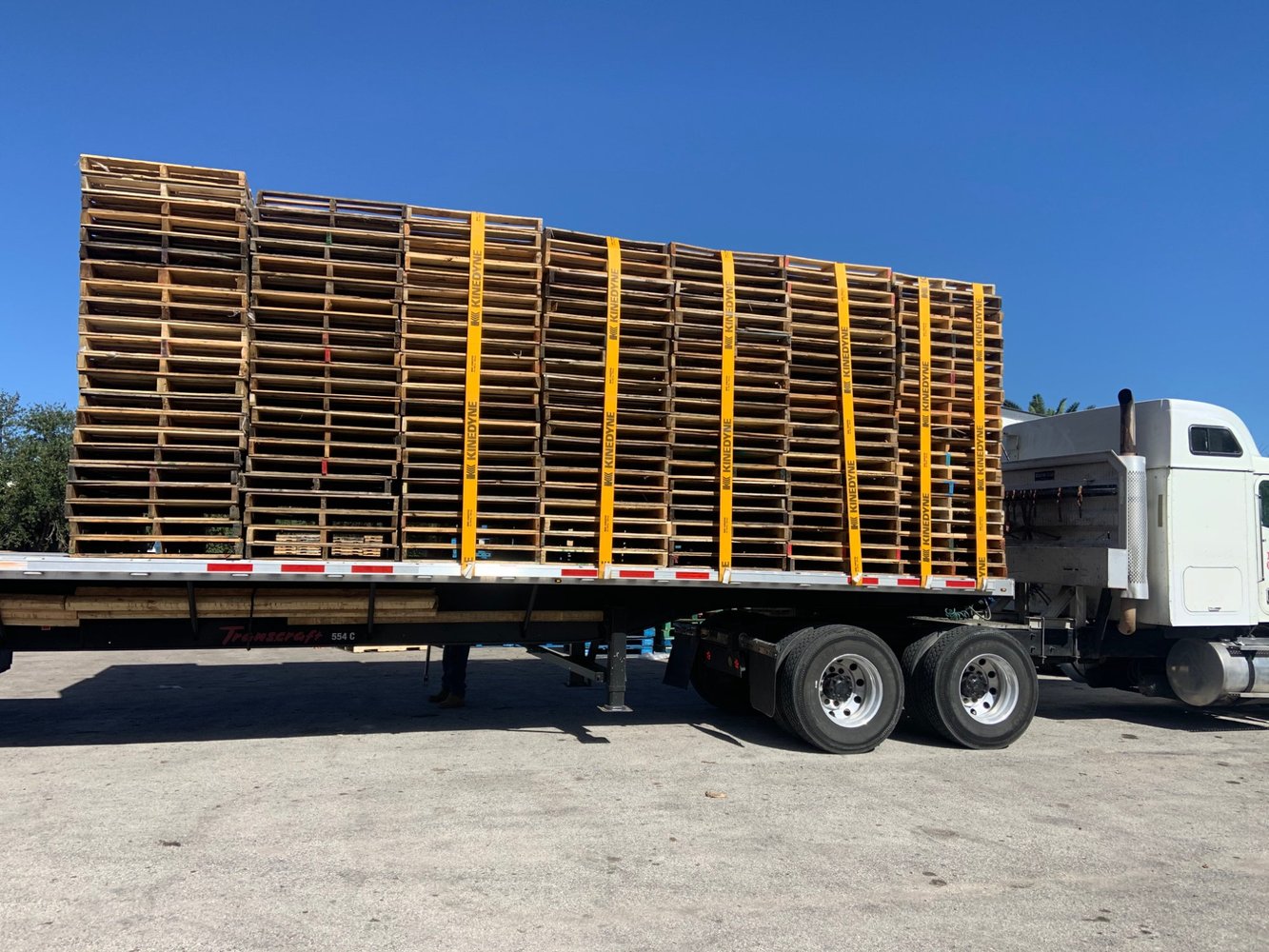
Agriculture Pallet Supply in Florida
Florida farms sold $9.24 billion of agricultural products in 2023, and USDA counts 44,400 farms and ranches on 9.7 million acres in 2024 (FDACS, from USDA NASS and ERS). Florida is the second-largest citrus state after California, produces 17% of the U.S. value of fresh-market tomatoes, and its two largest crop receipts are floriculture and sugarcane.
Florida's year-round growing season keeps agricultural pallet demand running in every month, from citrus packhouses and vegetable coolers to sugar mills and foliage nurseries.
Key Agriculture Hubs in Florida
Central Florida citrus belt (Polk, Highlands, Indian River counties)
Citrus packing houses and processing plants require field-durable pallets that can handle outdoor harvesting conditions as well as controlled-atmosphere storage. Polk and Highlands counties alone produced 6.3 million boxes of citrus in 2025-2026, and Indian River and St. Lucie grow most of the state's grapefruit (USDA NASS).
Immokalee tomato and produce operations
Fresh produce distribution centers require food-grade pallets with smooth deck boards and no protruding nails. Collier County, home to Immokalee, sold $388 million of agricultural products in the 2022 Census of Agriculture.
Belle Glade sugarcane region
Palm Beach County led every Florida county with $1.25 billion in agricultural sales in the 2022 Census of Agriculture, and sugarcane for sugar and seed brought Florida $909 million in 2023. Mills and bagged-sugar packers run heavy, uniform loads that suit new or grade A 48 x 40 stock.
Homestead tropical agriculture
Miami-Dade ranked second among Florida counties at $1.14 billion in 2022 agricultural sales, much of it tropical fruit, winter vegetables and nursery stock moving through Homestead packers and the Miami import market.
Plant City strawberry corridor
Hillsborough County, home to the Plant City strawberry district, sold $704 million of agricultural products in 2022, and Florida strawberries were worth $540.3 million in 2024. Berry flats ship palletized and pre-cooled, so clean, dry deck boards matter.
Apopka nursery/foliage capital
Wholesale nursery and greenhouse operations require unique pallet configurations for plant material handling. Florida floriculture sales reached $1.21 billion in 2024, 18% of the U.S. total, and Apopka foliage growers ship potted plants on pallets and racks to garden centers and landscapers nationwide.
Produce and Citrus Shipping Pallets in Florida (as of October 2026)
Most Florida produce and fresh citrus ships on a 48 x 40 inch GMA-style wood pallet, the footprint U.S. grocery distribution centers are built around. The 48 inch side is the stringer length, so a 48 x 40 and a "40 x 48" are the same pallet described from different sides. What changes from crop to crop is the grade, how clean and dry the deck has to be for pre-cooling, and whether the load is leaving the country and needs an ISPM 15 heat-treatment stamp.
Volume is the other variable. USDA NASS measures Florida citrus in field boxes with fixed net weights: 90 pounds for oranges and lemons, 85 for grapefruit and 95 for tangerines. The 2025-2026 crop came in at 15.66 million boxes, up 7% from the season before. Most oranges go to juice in bulk, so pallet demand concentrates in fresh packing: grapefruit and tangerines, which are mostly sold fresh, plus the packaged juice that leaves processing plants.
Florida citrus by variety, 2025-2026 season (USDA NASS preliminary summary, August 27, 2026)| Variety | Production (boxes) | Net lb per box | Approx. total weight | Fresh share |
|---|
| All oranges | 12.95 million | 90 | 1.17 billion lb | 11% fresh, 89% processed |
| Grapefruit (red and white) | 1.35 million | 85 | 115 million lb | 60% fresh |
| Tangerines and tangelos | 460,000 | 95 | 44 million lb | 65% fresh |
| Lemons | 900,000 | 90 | 81 million lb | Not split by NASS |
| All citrus | 15.66 million (up 7%) | | About 1.4 billion lb | |
Sources: USDA NASS Citrus Summary 2025-2026, Preliminary (production and fresh/processed use); USDA NASS January 2026 Citrus Forecast (net pounds per box). Total weight is boxes multiplied by net weight, rounded.
Where the fruit is grown matters for delivery planning. Polk (3.27 million boxes), Highlands (3.07 million), DeSoto (1.66 million), St. Lucie (1.40 million) and Hardee (1.31 million) produced 73% of the state's citrus in 2025-2026. Grapefruit is concentrated on the east coast in St. Lucie and Indian River counties, so most fresh citrus packing, and the pallets it uses, is concentrated there.
Matching the pallet to the load
Which pallet fits which Florida farm load (FPS field guidance, October 2026)| Load | Usual pallet | What to specify |
|---|
| Fresh citrus cartons to grocery DCs | 48 x 40 GMA, 4-way | Grade A or new, flush deck, no loose boards; receivers reject broken leads |
| Citrus to juice plants | Field bins and bulk trailers, not pallets | Pallets only for packaged juice and concentrate on the outbound side |
| Tomatoes, peppers, sweet corn | 48 x 40 GMA | Clean and dry for pre-cooling; ask whether the customer wants heat-treated stock |
| Strawberries and blueberries | 48 x 40 GMA | Smooth top deck, consistent height so forced-air cooling seals around the load |
| Nursery and foliage | 48 x 40 or custom deck | Open deck for drainage, or custom sizes for racks and Danish carts |
| Export by sea or air | Any size, HT-stamped | ISPM 15 heat treatment mark on every wood pallet leaving the U.S. |
Specs for the 48 x 40 footprint are in our GMA pallet standard guide and pallet spec reference. Food-contact and transport rules are covered in FSMA pallet requirements and food-grade pallets in Florida; export marking is in the ISPM 15 export guide. Packhouse bins and crates: citrus packhouse crates.
Agriculture Pallets in Other States
Other Industries in Florida
Food & Beverage
45% of all US pallet usage. Food-grade certified pallets for production, cold storage, and distribution.
Retail & Distribution
GMA 48x40 standards for DC racking, e-commerce fulfillment, and store replenishment.
Manufacturing
JIT delivery, custom sizes, and heavy-duty grades for production lines and finished goods.
Pharmaceuticals
FDA-compliant new pallets with traceability for cGMP manufacturing and cold-chain distribution.
Automotive
Custom rack pallets and JIT delivery for assembly plants and Tier 1/2 supplier operations.
Construction
Heavy-duty pallets for building materials, lumber, roofing, and building supply distribution.
Logistics & 3PL
Flexible pallet programs for 3PL clients with multi-industry and multi-grade requirements.
Import & Export
ISPM-15 heat-treated pallets for ocean container export and port-related import operations.
Cold Storage
Moisture-resistant pallets built for freeze-thaw cycling in refrigerated and freezer warehouses.
Chemicals & Hazmat
Industrial-grade pallets for chemical drums, IBC totes, and hazardous materials handling.
FAQ
Do you deliver agriculture pallets throughout Florida?
Yes. We deliver to all counties and cities in Florida. Our delivery network covers the entire state with dry van, flatbed, drop trailer, and live load options.
What pallet types are most popular for agriculture in Florida?
The 48 x 40 GMA-style wood pallet is the most popular for Florida agriculture because it is the footprint grocery distribution centers, cold storage racks and refrigerated trailers are built around. Fresh citrus, tomatoes, peppers, berries and sweet corn all move on it. Growers mainly vary the grade: new or grade A for retail-bound produce, grade B for internal moves and field use.
How quickly can you deliver to Florida?
Standard delivery to Florida locations is 1-3 business days. Rush delivery within 24-48 hours is available for urgent orders. Scheduled recurring deliveries are also available. Same-day dispatch runs from the Tampa, Orlando, Jacksonville, Miami, and Lakeland yards for orders within 75 miles, and next-day delivery is available statewide for orders placed by 2 PM EST.
How much does a box of Florida citrus weigh?
USDA NASS uses fixed net weights for Florida citrus boxes: 90 pounds for oranges, 85 pounds for grapefruit, 95 pounds for tangerines and mandarins, and 90 pounds for lemons. Florida harvested 15.66 million boxes of citrus in 2025-2026, which works out to roughly 1.4 billion pounds of fruit. Most oranges go to juice plants in bulk, while grapefruit and tangerines are mostly packed fresh and shipped on pallets.
Which Florida counties grow the most citrus?
Polk County led the 2025-2026 season with 3.27 million boxes, followed by Highlands (3.07 million), DeSoto (1.66 million), St. Lucie (1.40 million) and Hardee (1.31 million), according to USDA NASS. Those five counties produced 73% of Florida's citrus. St. Lucie and Indian River grow most of the state's grapefruit, so east coast packers ship the largest share of fresh, palletized citrus.
Do agricultural pallets need to be heat treated?
Only for export. Any wood pallet carrying produce out of the United States must be heat treated or fumigated and stamped under ISPM 15, and the receiving country can refuse or destroy loads without the mark. Domestic produce shipments do not require it, but some grocery and food-service customers ask for heat-treated stock anyway. Confirm with the receiver before you order, since HT pallets cost a little more.