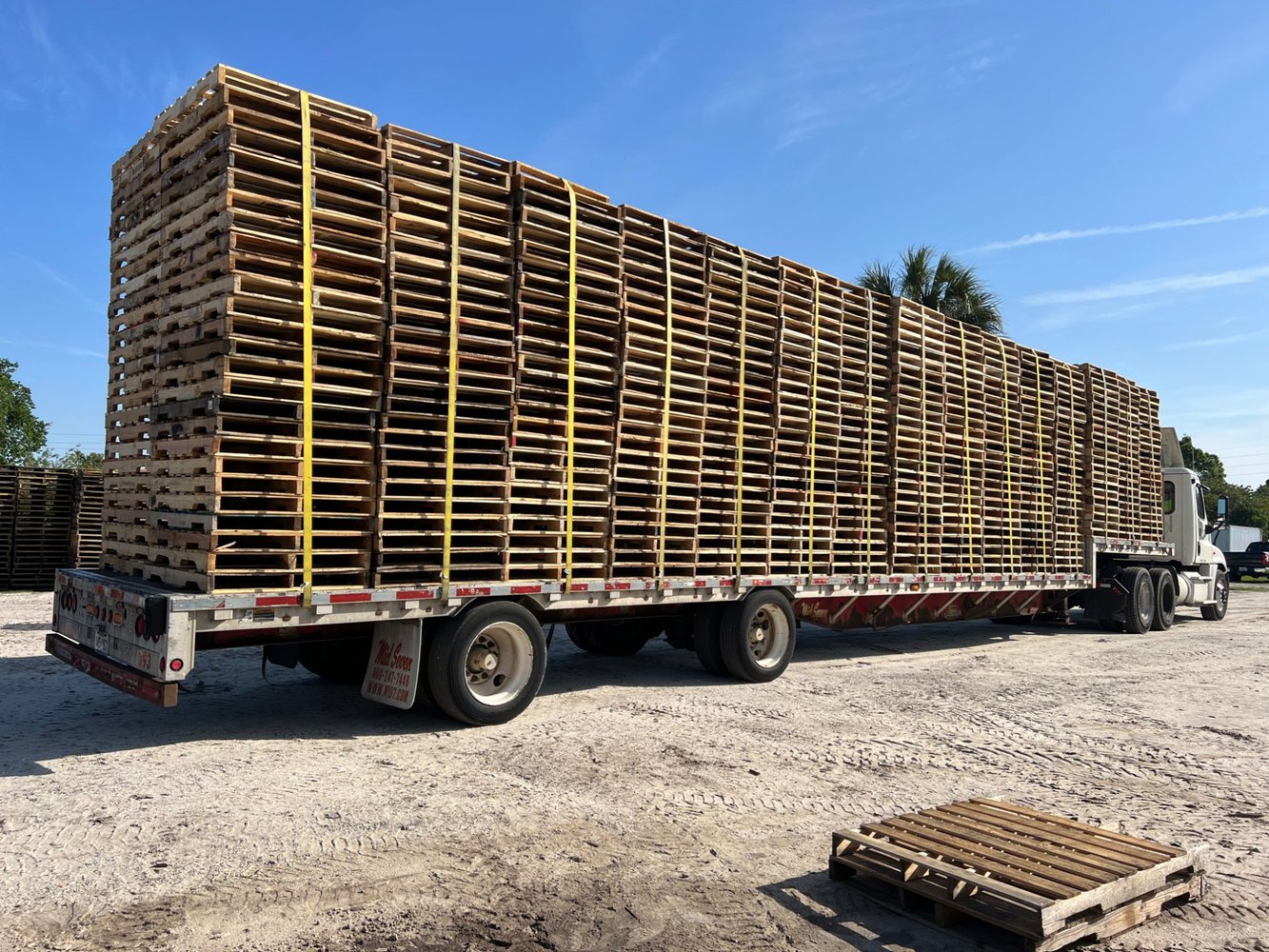
Operational details for Florida
Compliance specification
All pallets stamped IPPC HT for ISPM-15 export compliance to 180+ countries; documentation includes treatment temperature logs and the registered facility number.
Florida regulatory context
Port Tampa Bay phosphate operations under Tampa Port Authority Rule 7-04 require corrosion-resistant pallet specs; we supply heat-treated stock that withstands phosphate-rich environments.
Florida Sales Tax Exemption Form DR-46NT applies to pallets purchased for resale or for use in manufacturing of tangible personal property; we provide the form with every commercial invoice.
Pallet specification detail
ISPM-15 export pallets receive heat treatment to 56C core temperature for 30 minutes; stamping shows IPPC logo, country code 'US', registered facility number, and treatment code 'HT'.
Deck board edge type defaults to chamfered for forklift safety; square-edge available on request for ASRS compatibility; rounded-edge banding tracks available for high-throughput line-side delivery.
Delivery and logistics
Standing-order programs schedule a recurring weekly truckload (or partial) for the same delivery window; price-locked for 12 months; preferred for 3PL warehouse refill cycles.
Customer use case
Manufacturing customers running JIT (just-in-time) lines require pallets delivered to specific dock doors on 2-hour windows; we offer GPS-tracked delivery with 15-minute arrival ETAs.
Pricing context
ISPM-15 export documentation included on every applicable load at no additional cost; some competitors charge $50-150 per load for the certificate; we don't.
Sustainability
Pallet pooling reduces lifecycle waste 40-60% vs single-use models; our pool program manages inventory between participating customers with quarterly reconciliation.
Definitive Reference and Procurement Guide
Technical Specifications & Construction
Fork-pocket dimensions and fork-clearance specifications matter for warehouse equipment compatibility. Standard 48x40 GMA pallets provide 3.5-inch fork-pocket height (the gap between top deck and bottom deck created by stringers). This accepts standard 2-inch fork tine height with 1.5 inches of vertical clearance. Heavy-duty pallets with thicker stringers may reduce fork-pocket to 3.25 inches, requiring tine-height verification against your forklift fleet. Florida Pallet Supply confirms fork-pocket dimensions on every custom build to prevent dock-floor mismatch issues.
Florida Pallet Supply's quality management system follows ISO 9001 alignment principles with documented procedures for incoming lumber inspection, build-spec verification, finished-pallet QC, heat treatment monitoring, shipping documentation, and customer complaint resolution. Internal audits run quarterly; external customer audits are accepted on 30-day notice. Statistical process control charts track key dimensions (deck-board thickness, stringer thickness, nail count, moisture content) with control limits set at +/- 5 percent of nominal. Non-conformance is logged, root-caused, and corrective action implemented within 5 business days.
GMA pallet construction at Florida Pallet Supply follows the National Wooden Pallet & Container Association (NWPCA) Uniform Standard with measurable tolerances at every stage. Deck-board thickness measures 5/8 inch nominal; stringers are full 1.375 inch thick and 3.5 inches tall. Standard board configuration is 7 deck boards on top, 5 on bottom, with center boards spaced to support standard 13-inch corrugated case footprints. Nail count averages 50-75 helically-threaded 2.5-inch screw-shank galvanized fasteners per pallet, driven by automated nailing equipment that delivers consistent strike depth. Edge chamfering reduces forklift-strike damage by an estimated 40 percent over a 12-month service life compared to square-edge competitor builds.
Heat treatment to ISPM-15 specification at Florida Pallet Supply runs in computer-monitored kilns sized for 1,200-pallet batch loads. Wood core temperature is verified by 9-point thermocouple grid: 4 surface probes plus 5 deep-core probes inserted into representative deck boards on each batch. Compliance demands 56 degrees Celsius core temperature held for 30 continuous minutes; our standard cycle holds 58 degrees for 35 minutes for a documented compliance buffer. Each batch generates a treatment log with timestamp, temperature curve, kiln number, lumber lot reference, and inspector signature, archived in the chain-of-custody database for the full 7-year retention period required for export verification.
Frequently Asked Pallet Questions
What's the difference between CP and EUR/EPAL pallets?
CP (Chemical Pallet) series are specialized European specs designed for chemical industry export. CP1 measures 1200x1000mm, CP2 1200x800mm, CP3 1140x1140mm, CP9 1140x1140mm reinforced. All carry ISPM-15 heat treatment. EUR/EPAL pallets measure 1200x800mm, use an 11-board pattern, weigh ~25 kg, and are the dominant general-purpose European spec. Florida Pallet Supply builds both CP and EUR/EPAL for European exporters; lead time 7-10 business days, EPAL certification optional.
Can I mix new and recycled pallets in the same order?
Yes. Florida Pallet Supply ships mixed orders routinely. Common scenarios: new pallets for high-visibility customer-facing shipments (DTC e-commerce, retail-ready displays) and recycled Grade A for industrial inbound. Pricing applies per pallet type; freight bundles all types on a single truckload. Standing-order programs can lock pricing on a multi-type basket.
Do you offer per-pallet pricing or per-truckload pricing?
Both. Per-pallet pricing is standard for orders under 1,000 pallets per quote. Per-truckload pricing applies when orders fill a 53-foot dry van (~600 pallets for standard 48x40 GMA, ~300 for oversized custom). Truckload pricing typically saves 5-15 percent over per-pallet equivalent because freight bundles efficiently. Standing-order customers receive freight bundled into per-pallet pricing for predictable accounting.
What's the difference between pool pallets (CHEP, PECO) and owned pallets?
Pool pallets are owned by the rental company (CHEP blue, PECO red) and circulate in a closed-loop. You pay per trip and return them. Owned pallets are yours - bought once, depreciated over service life. Pool models work for closed-loop CPG-to-major-retailer flows (Costco, Walmart, Kroger). Owned models work for variable distribution lanes, export, custom specs, and any operation outside the major-retailer pool network. Florida Pallet Supply supplies owned pallets and supports the buy-back program at end-of-life.
What payment methods does Florida Pallet Supply accept?
Net 30 standard for established customers with credit approval. First three orders run Net 15 or COD. ACH transfer is preferred for invoice payment; credit card accepted with 2.5 percent processing surcharge above $10,000 per transaction. Wire transfer accepted for large orders and international customers. Letter of credit available for export orders over $50,000 on request.
Do recycled pallets carry the same load ratings as new pallets?
Yes - when properly inspected and graded. Recycled Grade A pallets must demonstrate no broken or replaced boards, fully legible GMA stamp, and pass dynamic load test before grading. Load capacity meets the 2,500 lb dynamic / 4,600 lb static specification per ASME MH1 2016. Recycled Grade B pallets retain structural integrity but show repaired boards; load capacity is typically reduced to 2,000 lb dynamic for non-critical industrial loads.
How is the IPPC stamp applied to ISPM-15 pallets?
The IPPC stamp is branded into the wood (not painted or stickered) on at least two opposite sides of each pallet, after heat treatment completes. The stamp shows the IPPC wheat-stalk logo, US country code, the facility's APHIS-registered number (assigned by USDA), and the HT treatment code. Hand-drawn, painted, or stickered marks are rejected at customs because they can be falsified. Stamp legibility must survive normal pallet handling for the full export trip.
What's the cost difference between same-day and next-day delivery?
Same-day delivery in 19 Florida same-day counties carries no premium over standard pricing for orders confirmed by 2 PM EST. Next-day statewide delivery also has no premium. Emergency dispatch (24/7 outside business hours) carries a $250-500 freight surcharge depending on origin yard and destination distance. Weekend dispatch with 24-hour notice runs $100-250 freight premium for premium-account customers.
Does Florida Pallet Supply offer kit pallets or knockdown pallets?
Yes. Knockdown (KD) pallets ship flat to save freight space and assemble on-site. Common for international shipments where dimensional weight constraints favor flat-pack. Florida Pallet Supply builds KD pallets in 48x40 GMA and custom sizes; assembly hardware (nails, brackets) included. Per-pallet pricing runs 10-15 percent higher than pre-assembled but freight savings often offset for trans-oceanic shipments.
Can I tour a Florida Pallet Supply facility?
Yes. Florida Pallet Supply welcomes customer tours of the Lakeland and Jacksonville processing yards. Tours typically take 90 minutes and include the receiving dock, inspection stations, heat-treatment kilns, build floor, dispatch staging, and quality records library. 30 days notice required for scheduling. Tours are common during initial vendor qualification and quarterly review for standing-order customers.
Can Florida Pallet Supply integrate with my WMS or ERP system?
Yes. Florida Pallet Supply offers API integration with major WMS systems including Manhattan Active, Oracle WMS Cloud, SAP EWM, Blue Yonder, HighJump, and Mecalux Easy. Custom integration with proprietary ERP systems supported via REST API or EDI. Per-pallet barcode data, lot traceability records, treatment certificates, and POD documentation flow automatically to the customer system.
What is the typical lifespan of a wood pallet?
Wood GMA pallets typically last 8-15 trips in a typical distribution cycle (warehouse to retail and back). Heavy-duty builds with reinforced stringers and 7/8-inch deck boards stretch lifespan to 20+ trips. Block pallets last longer than stringer pallets - typically 25-40 trips - because the continuous-face deck distributes load forces across nine support blocks instead of three stringers.
Florida Pallet Supply Case Studies
Procurement & Vendor-Qualification Notes
Vendor qualification timelines at major Florida operations (Publix, Walmart Florida DCs, Tropicana, Florida pharmaceutical distributors) typically run 60-120 days from RFP submission to first PO. Florida Pallet Supply provides standardized qualification packet within 48 hours of request, accelerating timeline to the customer-side review phase. Standing-order agreements typically execute within 21 days of qualified-vendor status approval.
Procurement managers evaluating Florida Pallet Supply for new vendor onboarding typically request: (1) APHIS facility registration certificate for ISPM-15 compliance, (2) ISO 9001 alignment documentation, (3) for HDPE stock, third-party lab test reports against FDA 21 CFR 177.1520 (olefin polymers) for food-contact use, and for wood stock the heat-treatment and handling records rather than a food-additive certificate, (4) sample lumber lot for incoming inspection, (5) reference customers in similar industry vertical, (6) financial stability indicators (D&B report, bonding capacity), (7) hurricane/disaster continuity plan documentation, (8) insurance certificate including general liability and product liability minimums.
Sourcing teams running pallet RFPs typically score Florida Pallet Supply against five dimensions: price competitiveness (per-pallet and total cost of ownership including freight), service reliability (on-time delivery rate, dock-scheduling integration capability), spec breadth (new, recycled, custom, ISPM-15, HDPE, specialty), compliance documentation (FSMA, GDP, ITAR, USMCA, ISPM-15), and sustainability program (Scope 3 reporting, buyback program, recycling diversion rate). Florida Pallet Supply scores in the top quartile on service reliability and spec breadth among Florida regional suppliers.
Authority and Citation References
Florida Pallet Supply maintains compliance with standards from the National Wooden Pallet & Container Association (NWPCA - palletcentral.com), USDA Animal and Plant Health Inspection Service (APHIS - aphis.usda.gov), International Plant Protection Convention (IPPC ISPM-15 - ippc.int), FDA Food Safety Modernization Act Section 204 (fda.gov), Random Lengths lumber pricing index (randomlengths.com), American Society of Mechanical Engineers MH1 pallet load standard (asme.org), Florida Department of Agriculture (FDACS - fdacs.gov), Customs and Border Protection wood packaging requirements (cbp.gov), Florida Citrus Mutual (flcitrusmutual.com), Florida Tomato Committee (floridatomatoes.org), and the Florida Customs House Brokers Association (flchba.com). Compliance documentation is provided with every export load at no additional charge and supports customer audits, internal QC review, and regulatory submission as required.