Real humans read every request · typical reply in 2 hours · All 67 Florida counties. Same-day dispatch in most FL metros. Standing weekly programs statewide.
FP
Florida Pallet Supply
Let's start0% done
Pallet Buyback & Recycling Programs How to Turn Surplus Pallets Into Cash
By Marcus Reed, Pallet Industry Specialist - Updated July 2026
Florida Pallet Supply • Updated July 2026
For most distribution and manufacturing operations, pallets are treated as a pure expense. But operations that accumulate Grade A recycled pallets - from inbound supplier shipments - are sitting on a sellable commodity. A well-structured pallet recycling program can recover 20-40% of your net pallet spend.
This guide explains how pallet buyback programs work, what your surplus pallets are worth, and how to structure a program that actually reduces your net pallet cost.
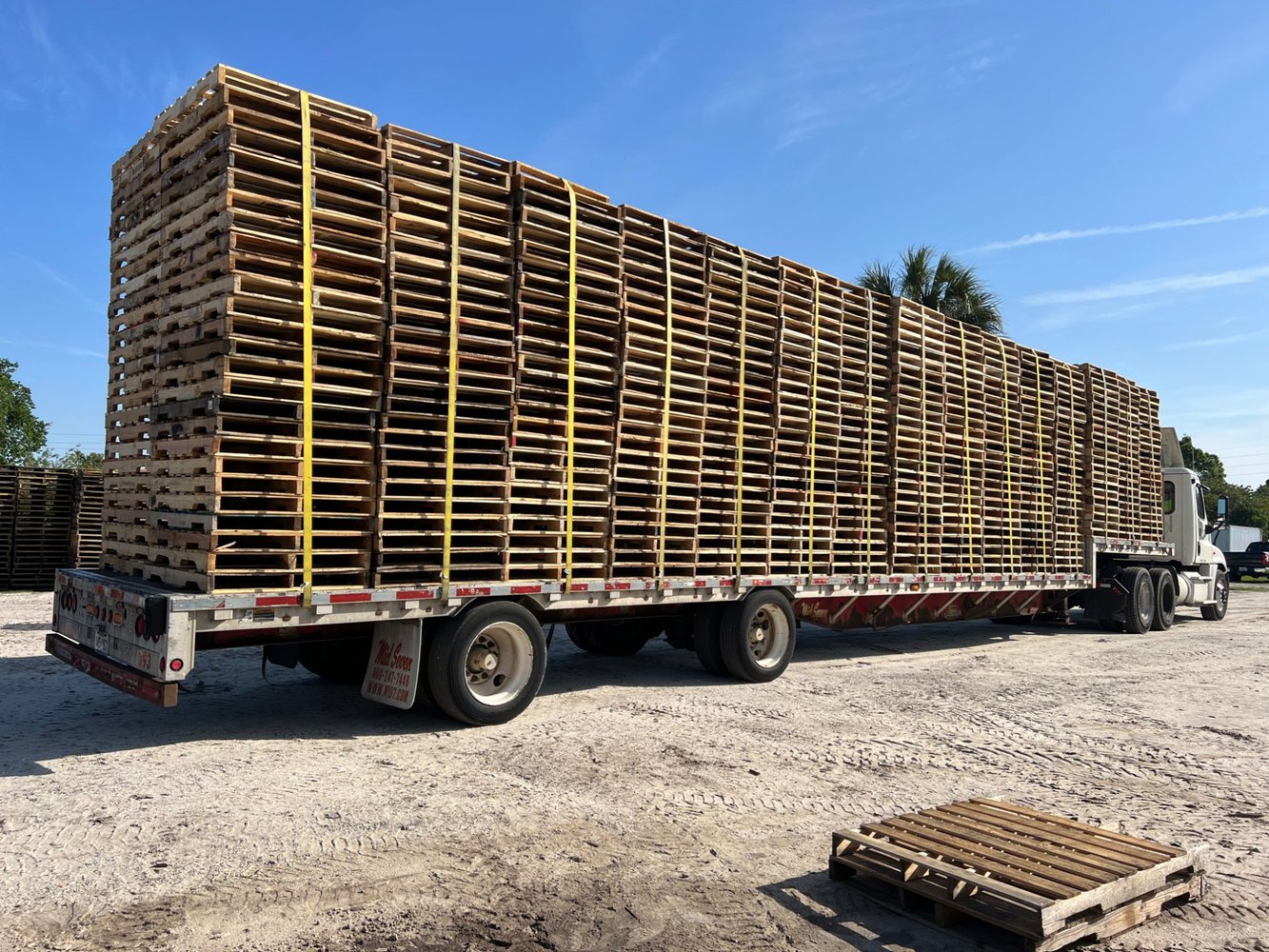
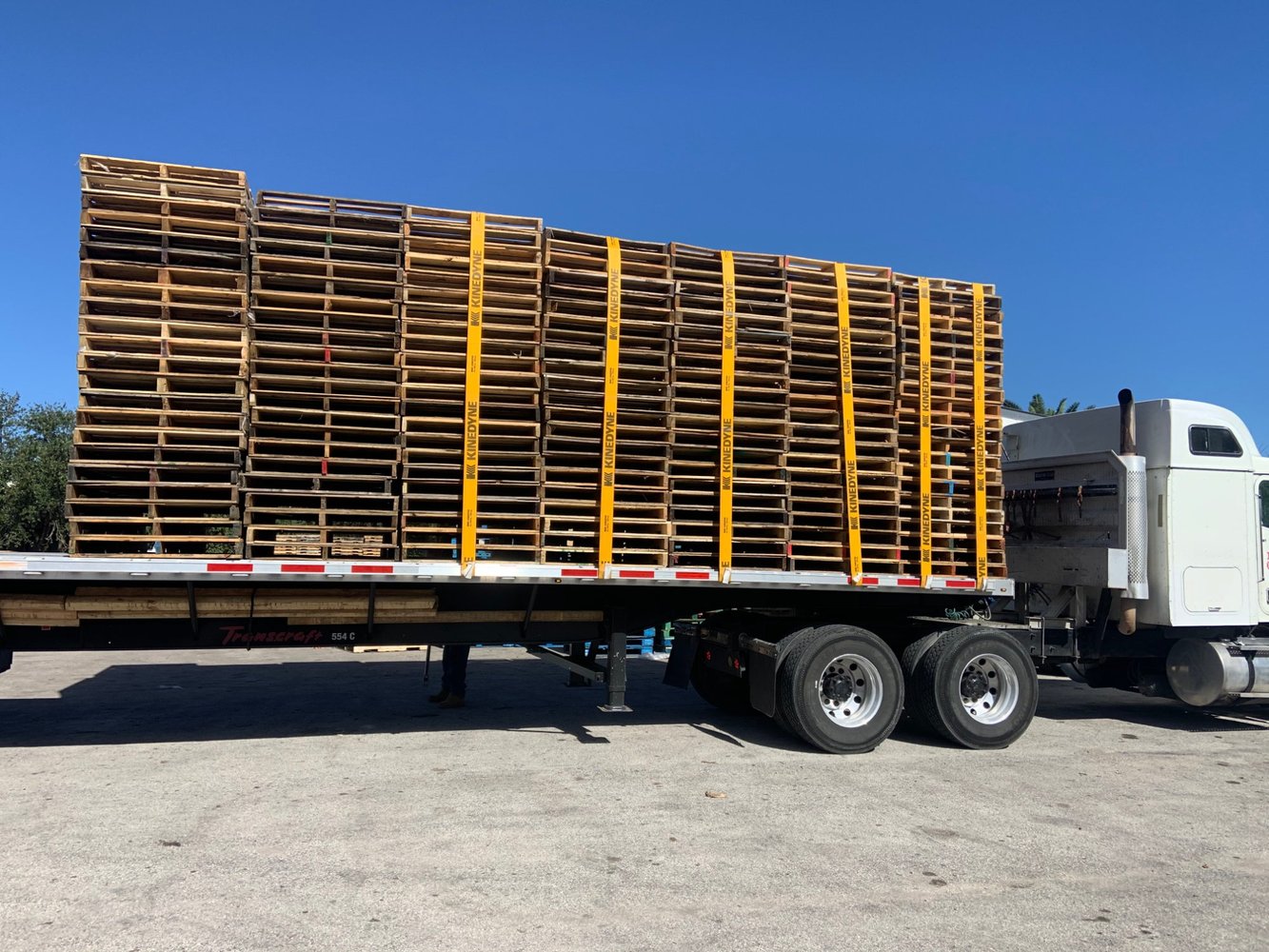
Pallet buyback inventory - we purchase Grade A recycled pallets throughout Florida
How Pallet Buyback Works
Pallet Lumber & Sawmill Operations
Stamped kiln-dried pallet lumber, bulk warehouse stock, dimensional yard inventory, raw softwood logs, and sawmill operations - the supply chain behind every custom and standard pallet we ship.
Kiln-dried stamped pallet lumber boards in stack at sawmillBulk pallet lumber storage in covered warehouse - dimensional pallet stockDimensional pallet lumber stacks with grading marks in lumber yardSoftwood pallet logs - raw timber for pallet lumber millingSawmill aerial view of lumber yard with pallet supply inventory
In a buyback program, your pallet supplier (or a separate pallet recycler) purchases your used pallets at an agreed price per unit. Buyback is typically available for GMA 48x40 Grade A pallets only - broken, heavily damaged, or non-standard pallets have little or no value. Your team sorts and stacks pallets as they accumulate, and the supplier picks them up (or you return them on outbound truck backhauls). Payment is by invoice credit or check per pickup.
What Are Surplus Pallets Worth?
Current Florida buy-back prices (2026 rates, as of July 2026, subject to lumber market fluctuation):
Prices fluctuate with lumber markets. Contact Florida Pallet Supply for current buyback rates.
Net Pallet Cost Calculation
If you buy Grade A recycled pallets at about $11 each and sell your used Grade A pallets back at around $7 each (the current Florida buy-back level), your net pallet cost is roughly $4 per pallet. For an operation cycling 500 pallets per week, recovering about $7 each on clean outbound stock returns roughly $3,500 per week that would otherwise be scrapped. The key is sorting and accumulating pallets cleanly - mixed, dirty, or damaged pallets drop into the $3 to $6 Grade B tier or the $1 to $3 scrap tier.
Setting Up a Buyback Program
To maximize buyback value: (1) Sort pallets at the receiving dock, not at the end of the month - mixed Grade A and Grade B lowers the average price. (2) Stack pallets in organized rows, not random piles - damaged pallets buried in a stack reduce the entire stack's value. (3) Agree on grade definitions and pricing with your supplier in writing before starting the program. (4) Coordinate pickups with your outbound truck schedules to avoid return-trip fuel costs. Florida Pallet Supply operates active buyback programs throughout Florida, Georgia, New Jersey, Maryland, and Delaware.
July 2026 Florida buy-back market note
Used-pallet buy-back stayed a net-cost lever for Florida operators through mid-2026. The most recent national used-pallet index (Q1 2026, 396 verified suppliers) put the average Grade A 48x40 at $9.04 resale with a $7.91 median, up about 54 percent since 2023, and Florida tracks near that national average. New-pallet cost is why buy-back pays: softwood lumber traded near $615 per thousand board feet in early July 2026, and a 10 percent Section 232 softwood tariff (in force since October 2025) stacked with Canadian duties keeps new-build lumber expensive. For Florida produce, beverage, and export shippers cycling heavy 48x40 volume, selling clean Grade A stock back at $6 to $9 instead of scrapping it is the difference between pallets as an expense and pallets as a recovered asset. Figures are market ranges as of July 2026, not quotes.
Buyback Program Models Compared (2026)
"Buyback" covers several arrangements. Which one fits depends on how many pallets you generate, how predictable your volume is, and whether you also buy pallets. Here is how the common models compare.
Model
How it works
Best for
Typical payout
One-time / spot sale
You call when pallets pile up; a buyer quotes and picks up that load
Irregular or one-off surplus
Per-load market price, no commitment
Standing scheduled buyback
Recurring pickup on a set cadence at an agreed per-grade rate
Steady, predictable weekly volume
Top of range; locked rate and priority pickup
Pallet exchange / credit
Buyback value is applied as credit against the pallets you purchase
Operations that both buy and return pallets
Credit lowers your effective per-pallet cost
Recycle-only pickup
Broken or unusable pallets hauled away for recycling
Damaged cores with no resale value
Little or no payment; avoids disposal cost
Program terms and rates as of July 2026 and vary by volume, grade mix, and location. Ask Florida Pallet Supply which model fits your operation.
What Belongs in a Pallet Buyback Agreement
Short answer: nine terms, and the two that move the most money are the grade definition and where the count happens. The setup checklist above says to agree on grade definitions and pricing in writing. This is what that writing should actually contain. Most buyback arrangements in this industry run on a phone call and an invoice, which works until the first load comes back a grade lower than expected and there is nothing to point at.
Term
What to specify
Why it protects you
What happens if you leave it out
Grade definitions
The physical test for each grade in words: stringer condition, number of missing or replaced deck boards, moisture and staining limits, and whether repaired pallets count.
"Grade A" is not an industry standard. It means whatever the grader at the receiving yard says it means.
The buyer's grader decides at pickup and you learn the outcome on the remittance.
Rate schedule and a floor
A per-grade rate for the term, plus a stated floor below which the rate cannot fall without your agreement.
Lumber moves. A floor keeps a program that penciled in January from going underwater in August.
The rate is whatever the market is on the day the truck arrives.
Price adjustment mechanism
If rates move, tie the move to a named published lumber or used-pallet index and a fixed review cadence, quarterly rather than on request.
Turns a renegotiation into arithmetic. Both sides can check it, and neither has to argue about direction.
Informal renegotiation whenever the buyer raises it, which is usually when the market has moved their way.
Who counts, and where
Count at your dock before loading, signed by both parties, or an agreed count at the buyer's yard with photo evidence and a dispute window.
The count and the grade are the only two inputs to your check. Location of the count decides who carries the risk of a disagreement.
The receiving yard's count is final.
Grade dispute resolution
A requirement that downgrades be photographed, a window to dispute, and a stated outcome for a disputed load.
Without it there is no way to challenge a downgrade, because the evidence has already been sorted into a stack.
No recourse once the truck leaves your lot.
Pickup service level
Days from request to pickup, and what happens when it slips.
Pallets you cannot stage occupy dock space and yard space, which is a real cost that does not appear in the per-pallet rate.
Pickup happens when a backhaul is already near you.
Minimum load and mixed-load pricing
The count that triggers a pickup, and exactly how a load containing more than one grade or size is priced.
This is where the largest avoidable loss lives. A single sentence decides whether a mixed load is priced by segment or as one lot.
The whole load is priced at the lowest grade present in it.
Payment terms and trigger
Net terms, method, and which event starts the clock: pickup, grading, or invoice receipt.
Grading-triggered payment can add weeks that a pickup-triggered term does not, at the same headline rate.
Payment follows the buyer's cycle after grading is complete.
Term, exclusivity and exit
Length of the agreement, whether you may sell surplus elsewhere, and the notice required to leave.
Exclusivity is worth giving up only for something specific in return, usually a rate floor or a pickup guarantee.
A handshake, and no leverage at renewal.
Procurement guidance from Florida Pallet Supply buyback program setups, current as of August 2026. Terms are commercial practice, not legal advice, and a buyback agreement should be reviewed by your own counsel before signing.
Why the grade definition is worth more than the rate
Operators negotiate hard on the headline rate and then accept whatever grade the load is assigned, which is backwards. Using the published Florida bands on this page, the distance between the top of Grade A and the bottom of core is $8 per pallet. On a 500-pallet load that is $4,000, decided entirely by which column the load lands in. No rate negotiation available to you moves that much money. Write the grade test down, photograph a sample load that both sides agree is Grade A, and keep that photo with the agreement as the reference the grader is measured against.
The three questions to ask before you sign
(1) If lumber falls 20 percent next quarter, what happens to my rate, and does the same rule apply if it rises. (2) If we disagree about a grade, who has the evidence and how long do I have to raise it. (3) If I generate a mixed load in a busy week, is it priced by segment or as one lot. A buyer who answers all three plainly is running a program. A buyer who cannot is running a spot purchase and should be priced as one.
The Second Thing a Buyback Program Produces: a Diversion Number
A buyback program pays twice. The cheque is the visible half; the documented diversion figure is the half that shows up in a customer questionnaire, a retailer scorecard or an annual report. Most facilities set the program up for the cheque and then discover, usually during an audit or a customer review, that nobody captured what left the yard or where it went.
The scale is worth stating plainly, because it is larger than most operations assume. The US Environmental Protection Agency tracks wood containers and packaging as its own material stream, which it describes as mostly wood pallets as well as wood crates. These are the most recent figures EPA publishes for that stream, and the data year is 2018. They are national totals, not a benchmark for any single site.
Disposition
Tons (2018)
Share of wood packaging generated
What it means at your dock
Generated
11.5 million tons
100 percent, and 3.9 percent of all US municipal solid waste
The size of the stream your surplus sits inside.
Recycled
3.1 million tons
about 26.9 percent
EPA counts pallets chipped for mulch and animal bedding here, and excludes wood burned as fuel.
Combusted with energy recovery
1.65 million tons
about 14.3 percent
Counted separately from recycling, which is why a supplier who says wood is recovered has not yet told you it was recycled.
Landfilled
6.78 million tons
about 58.8 percent
The majority disposition. This is the number a buyback program is measured against.
Source: US Environmental Protection Agency, Containers and Packaging: Product-Specific Data, wood containers and packaging series, 2018 data year. Percentages are calculated from the published tonnages.
The row that matters is the last one. Close to three fifths of wood packaging generated in that year was landfilled, and roughly a quarter was recycled. A facility that sells its surplus into a buyback program is moving tonnage out of the 58.8 percent row and into the 26.9 percent row, and that movement is reportable in a way the cheque is not.
Capturing it costs almost nothing if it is set up with the program rather than reconstructed afterwards. Five fields are enough:
The count, split by the grade the buyer actually paid at rather than the grade you staged.
An average weight per grade, measured once on your own scale, not taken from a supplier sheet.
The destination and its role: repaired and reissued, ground for mulch or bedding, or burned for energy.
The collection date and the carrier, which is what lets the figure be audited later.
The disposal cost the load would otherwise have carried, which is the other half of the saving.
Two cautions, both of which cut against the section above. The EPA figures are a 2018 national series covering all wood packaging, so they describe the market your surplus sits in and prove nothing about your own recovery rate: the only defensible number is the one your own records support. And recovery is not recycling. EPA counts combustion with energy recovery in a separate row for a reason, so a buyer who says your pallets are recovered has answered a different question from the one a customer scorecard is asking. Ask where the load goes, in those terms, before the first collection rather than after the first audit.
Frequently Asked Questions
A one-time sale clears a single pile of surplus pallets at the going market rate with no commitment. A standing buyback is a recurring pickup on a set schedule at an agreed per-grade rate, which usually pays the top of the range and gives you priority pickup because the buyer can plan around your volume. If you also purchase pallets, an exchange or credit model applies the buyback value against your orders to lower your effective per-pallet cost.
Broken pallets have scrap value only (about $0.25 to $0.75 each) if at all. Core or broken pallets are disassembled for lumber, not resold as functional pallets. Investing in a basic repair station (hammer, nails, spare boards) to repair Grade B back to Grade A can more than double the buyback value per pallet.
Yes, significantly. Pallet pricing tracks lumber commodity markets, which can move 20-40% in a year based on housing construction demand, mill capacity, and transportation costs. Locking in pricing with longer-term agreements reduces exposure to market spikes.
Some large recyclers offer free pickup for volume accounts (1,000+ pallets per pickup). For smaller volumes, pickup fees or return-trip coordination with delivery trucks is typical.
Need Pallets?
Florida Pallet Supply delivers new, recycled, and custom pallets across FL, GA, NJ, MD & DE. Fast quotes, reliable weekly delivery.
Pallet buyback programs are arrangements where pallet suppliers or recyclers purchase used pallets from businesses at a per-unit price that offsets the cost of new pallet purchases. Buyback rates for GMA 48x40 pallets in 2026 range from about $1 to $9 per pallet depending on grade, condition, quantity, and local market demand (Grade A about $6 to $9, Grade B about $3 to $6, and cores or broken pallets about $1 to $3). Businesses that generate large volumes of outbound pallet waste - warehouses, manufacturers, retailers, and food processors - can reduce net pallet costs by 20% to 40% through consistent buyback participation.